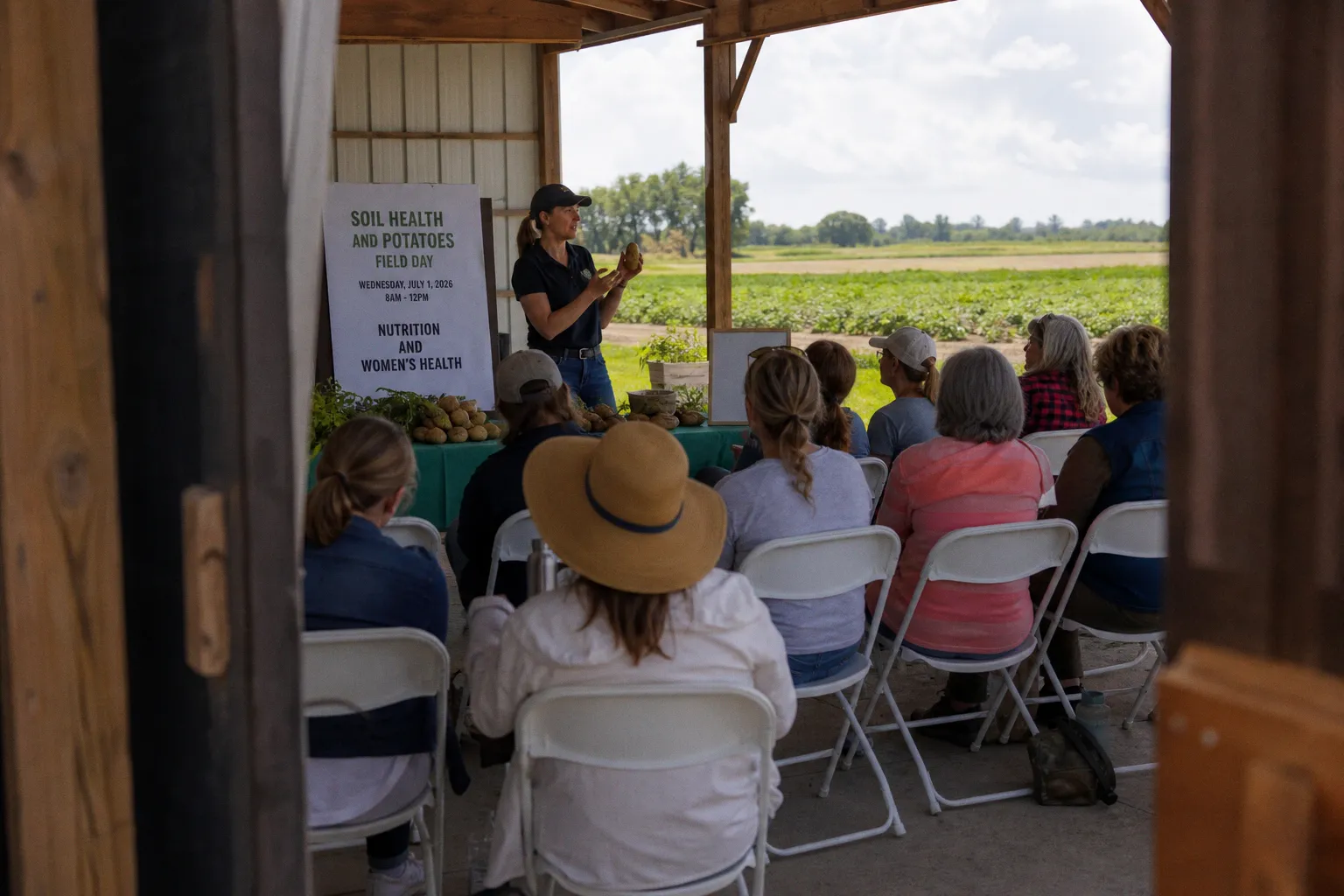
Soil Health and Potatoes Field Day, Wednesday, July 1, 2026, 8am - 12pm - Nutrition and Women’s Health
The University of Idaho will host a Soil Health and Potatoes Field Day on Wednesday, July 1, 2026, from 8:00 a.m. to 12:00 p.m., positioned within its federally funded COBRE in Nutrition and Women's Health.
Institutional Context: COBRE Phase 1 and the NIGMS Infrastructure
The field day operates under the Center of Biomedical Research Excellence (COBRE) in Nutrition and Women's Health, established at the University of Idaho in March 2024. Funding derives from an $11 million, five-year award (P20GM152304) issued by the National Institute of General Medical Sciences, with the NIH Office of Women's Health and the Office of Nutrition Research listed as programmatic partners. Idaho qualifies as an Institutional Development Award (IDeA)-eligible state, a designation reserved for jurisdictions with historically low NIH funding density.
Phase 1 priorities are capacity-building rather than hypothesis-driven output: the explicit mandate is to recruit, mentor, and retain a critical mass of investigators capable of competing for independent federal funding, alongside infrastructure upgrades in nutrition and women's health research.
- Scope: Entire lifespan; both undernutrition and obesity; outcomes spanning fertility, eating disorders, nutrient deficiencies, chronic disease, and mental health.
- Methodological posture: Broad, interdisciplinary, collaborative—encompassing all nutrients and food bioactives relevant to health.
Potatoes as a Nutritional Vector
The selection of *Solanum tuberosum* as a focal commodity is methodologically defensible rather than incidental. White potatoes contribute measurable quantities of potassium, vitamin C, and resistant starch to dietary intake, with bioavailability profiles conditional on cultivar genetics, soil mineral composition, and post-harvest handling. Trials indicate that tuber potassium density tracks soil potassium availability, suggesting the field-day format offers a tractable system for examining soil-to-edible-tissue mineral transfer before any scaling to human metabolic endpoints.
The Nutrition Analytics Core Laboratory (NACL; RRID: SCR_025661), housed in the Food Research Center building, is the downstream analytical anchor. The lab comprises a centralized "hub" suite and a distributed network of partner laboratories, with Technology Access Grants (TAGs) available to faculty and students conducting relevant research. Inquiries route through [email protected].
What to Verify on Site
For professionals tracking translational infrastructure:
- Whether soil sampling protocols extend to trace minerals and heavy metals relevant to reproductive and bone health—not merely bulk macronutrient panels.
- Whether cultivar comparisons include resistant starch quantification, a variable with documented relevance to glycemic and satiety outcomes.
- Timeline for COBRE phase 1 deliverables and the conditions under which external collaborators outside the IDeA-eligible network may access NACL capacity.
The data needed to assess whether this program generates statistically meaningful findings will not emerge on July 1. What can be assessed now is whether the institutional architecture supports the kind of longitudinal, soil-to-clinical-trial integration that current nutrition science requires. Early indicators are structurally encouraging; biochemical verdict, as always, must await published methodology and peer-reviewed outcomes.