Colibrim screening mistakes in dietary supplement analysis
“Colibrim screening” sounds like the name of a lab workflow. It isn’t. That is the first and biggest mistake people make when searching for dietary supplements Colibrim: treating a commercial product…
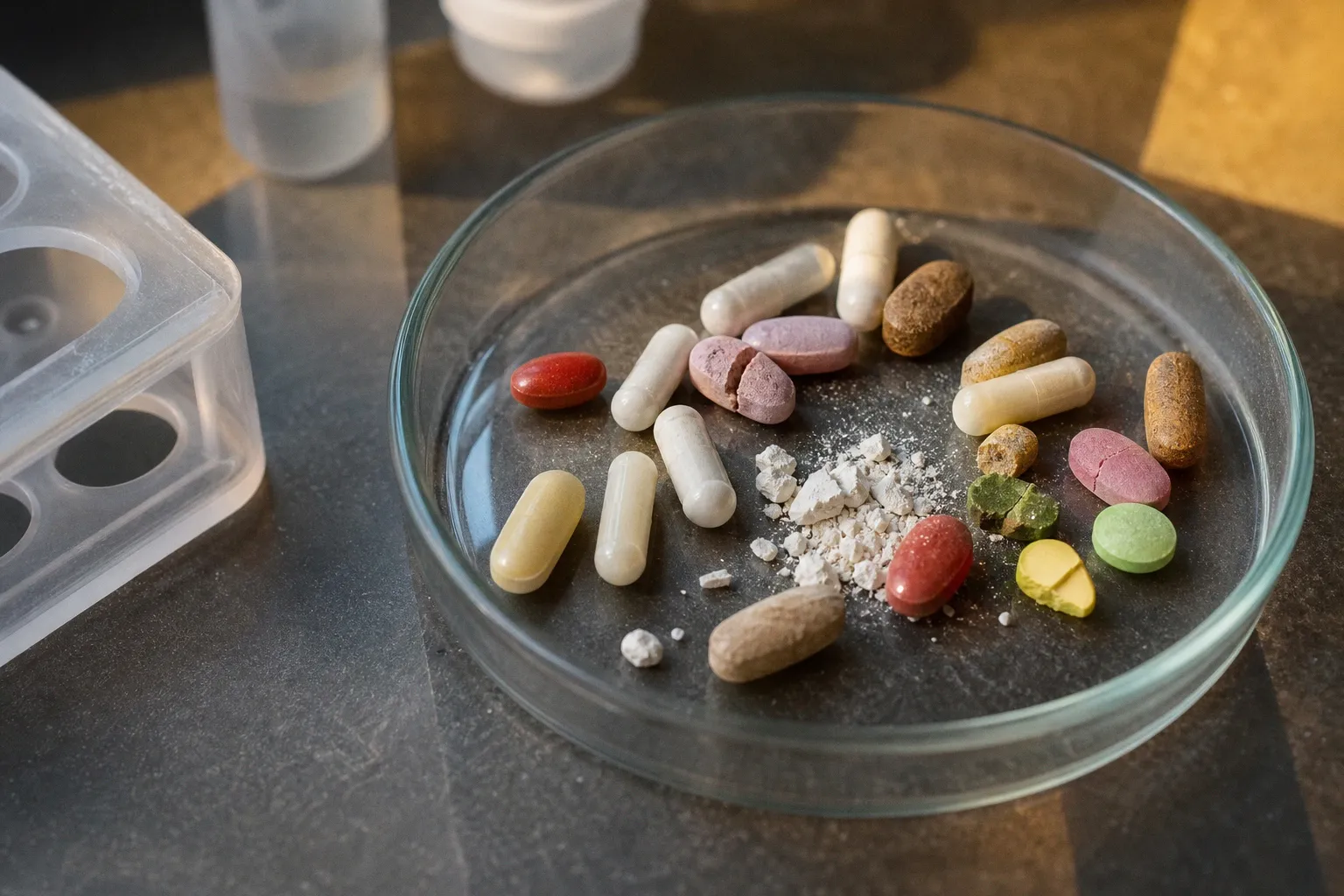
“Colibrim screening” sounds like the name of a lab workflow. It isn’t. That is the first and biggest mistake people make when searching for dietary supplements Colibrim: treating a commercial product platform as though it were an analytical method used to identify chemicals, verify dosage, or flag adulteration.
Colibrim is associated with health-product listings, reviews, and supplement marketing—particularly in categories like weight management, prostate support, and cardiovascular products. That may be useful context for a shopper. It does not turn Colibrim into an LC-MS/MS instrument, a validated database, or a laboratory protocol. Different universe. Same internet confusion.
The distinction matters because supplements already operate in a market where the label can be more optimistic than the contents. If you want to know whether a capsule contains the botanical extract, amino acid, stimulant, or probiotic strain printed on the bottle, you need analytical chemistry. Not a marketplace search result. Not a product-rating page. Not a slick “screening” badge with a molecule icon pasted next to it.
A product platform can organize claims. It cannot verify what is inside a capsule.
Colibrim is a brand context, not a chemical-analysis method
The phrase “colibrim database screening” creates a tempting but incorrect mental picture: an analyst feeds a supplement sample into a system, compares it against a Colibrim reference library, and gets a green or red result. Nice story. No basis for it.
In dietary supplement chemical analysis, a screening method has specific plumbing behind it:
- A defined sample-preparation procedure: grinding, extracting, filtering, diluting, sometimes hydrolyzing.
- An instrument with known performance characteristics.
- Reference standards for target compounds.
- A library or database with traceable spectra, retention times, or molecular transitions.
- Validation data showing the method can reliably detect and quantify what it claims to detect.
- Rules for handling uncertainty, interferences, false positives, and false negatives.
Colibrim, by contrast, is a commercial platform and marketplace context. It may display products and product claims. It is not an established laboratory methodology, analytical software package, or scientific screening protocol.
That does not mean every product mentioned on such a platform is automatically bad. It means the platform itself cannot be used as proof of identity, purity, dosage, or safety. Those are separate questions, answered with separate tools.
The wording trap: “screening” means different things in different rooms
The supplement business loves flexible language because flexible language sells. “Screened,” “tested,” “verified,” “reviewed”—all useful words, all capable of meaning very little without details.
Here is the practical distinction.
| Term | What it may legitimately mean | What it does not prove |
|---|---|---|
| Product marketplace review | A product has been listed, described, or compared for consumers | The formula matches the label or has been independently lab-tested |
| Ingredient screening | A laboratory looked for selected target compounds or contaminant classes | Every possible adulterant or impurity has been ruled out |
| Identity testing | A method confirmed the presence of a specified ingredient | The ingredient is present at the promised dose |
| Potency assay | A method measured how much of a target compound is present | The product will produce the claimed health effect |
| Third-party certification | A certifier assessed a product or facility against a specified program | The product is clinically effective for every marketing claim |
Notice the pattern: each result answers a narrow question. Anyone telling you one logo answers all of them is selling a shortcut. The supplement aisle has plenty of those already.
The real problem: labels, contents, and release can disagree
If the phrase “Colibrim false positives” brought you here, redirect the concern. The larger risk is not that a fictional Colibrim method incorrectly identified a compound. The risk is assuming that an ingredient list is self-authenticating.
Dietary supplements are not pre-evaluated for effectiveness by regulators such as the FDA before they reach the market. That is the awkward bit many consumers discover after spending money, not before. Manufacturers carry responsibility for product safety and labeling, but a bottle does not undergo the same premarket effectiveness review expected for a prescription drug.
That regulatory setup does not mean all supplements are junk. It means the burden of proof does not arrive in a neat little package with every bottle.
Consider what can go sideways even when the front label looks conventional:
1. The active ingredient is under-dosed or over-dosed.
In one assessment of supplements containing proline, measured content ranged from 73% to 121% of the declared amount in capsules. In tablets, the range ran from 103% to 156%. That is not trivial drift. At 156%, “one tablet” has stopped meaning what the label says it means.
2. The active ingredient may not release properly.
Content is not the whole game. A tablet can contain the stated amount and still fail to release it in conditions meant to simulate the stomach. In the proline assessment, five of seven analyzed supplements showed release rates below 80% at pH 1.2. The ingredient may be in the tablet, but your body does not take supplements by reading the label.
3. Botanical identity can be messy.
Plant extracts are not single molecules unless the manufacturer has standardized them to a specific marker compound. “Turmeric extract,” “green tea extract,” or “ashwagandha” can describe raw materials with very different chemical profiles. The botanical Latin name, plant part, extraction solvent, extract ratio, and standardization marker all affect what the material actually is.
4. Multi-ingredient blends muddy the analytical water.
A blend containing caffeine, amino acids, herbal extracts, vitamins, flavors, sweeteners, and pigments is not a simple sample. One ingredient can interfere with another during testing. Some compounds degrade during extraction. Others hide behind a crowded chromatographic peak. That is why competent labs do not treat every supplement like a glass of orange juice.
5. Adulteration can target the expected effect.
Weight-loss, sexual-enhancement, and performance products are recurring high-risk categories because the commercial incentive is painfully obvious. If a supplement promises drug-like results while supposedly containing a handful of herbs, a lab should ask whether undisclosed pharmacologically active compounds are doing the heavy lifting.
“Natural” on the front panel is marketing vocabulary, not an analytical result.
How supplement bioactive identification actually works
A proper dietary supplement analysis starts with a brutally basic question: what exactly are we trying to find?
That sounds obvious. It isn’t. “Test this supplement” is not a test plan. A lab needs a target list, expected concentration ranges, the dosage form, the matrix, and a reason for looking. Are we verifying vitamin D? Measuring caffeine? Checking whether a probiotic contains a named strain? Screening a weight-loss powder for undeclared stimulants? Each job needs a different method.
Step 1: Define the analytical question before touching the sample
The lab first separates the claims into testable pieces.
For a typical supplement, that may mean:
- Identity: Is the declared ingredient present?
- Assay or potency: How much is present per capsule, scoop, or tablet?
- Uniformity: Does one unit resemble the next, or is the batch uneven?
- Dissolution or disintegration: Will the dosage form break down and release its contents?
- Contaminants: Are there heavy metals, residual solvents, microbes, pesticides, or undeclared drugs?
- Stability: Does the product still meet specification near the end of its shelf life?
A lab that tries to answer all six questions with one generic “screening” pass is either cutting corners or selling a very ambitious brochure.
Step 2: Get the sample preparation right
This is where glamorous marketing claims go to die in a centrifuge tube.
Capsules may be opened and pooled. Tablets are ground to a uniform powder. Oils need different solvents than water-soluble vitamins. Gummies bring sugars, gelatin or pectin, acids, colors, and flavor systems that can complicate extraction. A probiotic needs viability and strain-identification work, not merely a chemical assay.
The analyst then chooses extraction conditions that recover the target without wrecking it. Too much heat can damage unstable vitamins. The wrong solvent can leave part of a botanical profile behind. A harsh extraction can create artifacts—chemical changes caused by the test itself. Congratulations: now you have measured the lab process rather than the supplement.
Step 3: Use the instrument that fits the question
Two major tools appear repeatedly in serious supplement work: LC-MS/MS and FTIR. They do different jobs. Neither is magic.
| Technique | Best use in supplement work | Strength | Common limitation |
|---|---|---|---|
| LC-MS/MS | Targeted identification and quantification of many vitamins, alkaloids, pharmaceuticals, and bioactives | Highly sensitive and selective when properly validated | Needs appropriate standards, method development, and careful control of matrix effects |
| FTIR spectroscopy | Rapid material fingerprinting, raw-material comparison, and some identity checks | Fast and relatively low-prep | Less suitable for reliably quantifying trace compounds in complex multi-ingredient formulas |
| Chromatography with UV or fluorescence detection | Routine assay for suitable known ingredients | Efficient for well-characterized targets | Can struggle when compounds overlap or the matrix is crowded |
| Microbiological or molecular methods | Probiotic count, organism identity, and strain work | Necessary for living organisms | Chemical methods alone cannot establish viable count or strain-level claims |
| Dissolution testing | Assessing release from tablets and capsules | Reveals whether the dosage form performs physically | Does not, by itself, prove clinical absorption or effectiveness |
LC-MS/MS—liquid chromatography coupled with tandem mass spectrometry—is the workhorse when the question is “is this compound here, and how much?” Liquid chromatography separates components in the extract. Mass spectrometry then detects molecules by their mass-to-charge behavior and fragmentation pattern. The acronym is ugly. The logic is clean: separate first, identify second, quantify against standards.
FTIR—Fourier transform infrared spectroscopy—looks at how a material absorbs infrared light. Different chemical bonds absorb in characteristic regions, giving a kind of chemical fingerprint. It can be extremely useful for comparing incoming raw materials to a known reference or spotting gross substitution. But do not ask it to carry a task it was not built for. A complex fat-burner blend with dozens of low-level ingredients can make FTIR results look confident while saying far less than people think.
Step 4: Confirm, quantify, and challenge the result
An early instrumental signal is not the final answer. This is where the phrase “false positive” actually belongs.
A false positive occurs when a method reports a compound as present when it is not. In supplements, that can happen because of:
- A chemically similar compound producing a confusing signal.
- Co-eluting ingredients—two substances leaving the chromatographic column at nearly the same time.
- Carryover from a previous high-concentration sample.
- Contamination from glassware, solvents, or the environment.
- Poorly chosen mass-spectrometry transitions.
- A library match that looks plausible but has not been confirmed with a reference standard.
- Data processing set to “find something” rather than “prove something.”
The antidote is not a bigger marketing database. It is method validation and confirmation.
A responsible lab uses blanks, controls, calibration standards, replicate preparations, recovery studies, and confirmation criteria. For high-stakes findings—especially a suspected undeclared drug—the lab should use an appropriate confirmatory approach, compare against a certified reference material where possible, and document the chain of custody. That is less exciting than a dashboard with a green checkmark. It is also how you avoid accusing a product of containing a drug because a flavor compound made the software nervous.
Why a database alone cannot certify a supplement
Databases are useful. They are not judgment.
An analyst may use spectral libraries, mass databases, ingredient monographs, botanical reference collections, and lists of known adulterants. But a database match is an investigative lead, not necessarily a final identification. In a clean pharmaceutical sample, a match may be straightforward. In a supplement containing fifteen plant extracts, minerals, flavoring agents, and a proprietary blend? The matrix comes to the party.
For botanical products, the problem gets even more entertaining. A label may name an herb while saying little about:
- The exact species.
- The part used: root, leaf, seed, bark, or whole plant.
- The extraction solvent.
- The herb-to-extract ratio.
- The marker compound used for standardization.
- Whether the stated quantity refers to raw herb equivalent or actual extract mass.
- The natural variation between harvests.
A generic database entry cannot resolve all that. Nor can a branded marketplace label.
If you are evaluating a supplement for personal use, the useful public-facing signals are more mundane:
- A full Supplement Facts panel rather than a vague proprietary blend hiding individual doses.
- A batch or lot number and a real manufacturer or responsible distributor.
- Transparent ingredient forms: for example, magnesium citrate versus “magnesium complex.”
- A certificate of analysis that identifies the lot and the specific tests performed—not a floating PDF that could belong to any batch from any year.
- Testing that matches the risk: heavy-metal data for mineral-rich botanicals, microbial testing for susceptible powders, identity and potency work for active ingredients, and adulterant screening for high-risk categories.
Even then, read the paperwork like an adult. A certificate of analysis is only as useful as its scope. A report showing “passes for lead” says nothing about caffeine dose, pesticide residues, or an undeclared pharmaceutical. One test is one test. Shocking, I know.
Regulation leaves room for quality—and plenty of room for noise
The regulatory line between dietary supplements and medicines creates a predictable consumer misunderstanding. People see capsules, dosage instructions, health language, and scientific-looking labels. They infer drug-level premarket proof. That inference does not hold.
Supplements are generally sold without premarket evaluation for effectiveness by the FDA. Manufacturers are responsible for ensuring that their products are safe and properly labeled, but the practical quality picture can vary sharply by company, ingredient, and category.
That is why product quality needs to be discussed in layers rather than as a binary “safe” or “unsafe.”
Ingredient quality is not the same as finished-product quality
A manufacturer may buy an acceptable raw material and still produce a poor finished supplement. Problems can arise during blending, encapsulation, tableting, packaging, or storage.
For example:
- A hygroscopic ingredient pulls moisture from the air and degrades in a poorly designed bottle.
- A tablet is compressed too hard and fails dissolution.
- A low-dose bioactive is mixed unevenly through a large batch.
- Omega-3 oils oxidize if oxygen control and packaging are weak.
- A probiotic’s viable count declines long before the printed expiry date if temperature exposure gets out of hand.
- A botanical extract is authentic but standardized to a marker that does not represent the whole pharmacologically relevant profile.
No single seal erases these risks. Quality is a chain. Break one link, and the label becomes a work of fiction with a barcode.
The risk profile changes by supplement category
Not every supplement deserves the same level of suspicion. A straightforward single-ingredient mineral product presents different analytical challenges from a stimulant-heavy powder or a multi-herb sexual-enhancement capsule.
A sensible risk hierarchy looks like this:
1. High-risk performance, weight-loss, and sexual-enhancement products
These deserve serious concern about undeclared pharmacologically active ingredients because strong promised effects create strong incentives. Look for credible third-party testing and avoid miracle claims.
2. Complex botanical blends
The identity problem is real. More herbs means more opportunities for substitution, dilution, contamination, and ambiguous dosing.
3. Probiotics
The label should provide meaningful organism information, ideally including strain designation where relevant, plus a viable count through expiration rather than merely “at manufacture.” A dead probiotic is a very expensive historical record.
4. Fatty-acid supplements
Potency matters, but oxidation matters too. “Fish oil 1,000 mg” is not the same as 1,000 mg of EPA and DHA. The label needs to make that distinction visible.
5. Simple vitamins and minerals
These are often easier to assay, but dose accuracy, formulation, and release still matter. The proline results are a useful reminder: simple does not mean automatically consistent.
The more dramatic the promise, the less you should accept a vague answer about what is actually in the bottle.
What to do instead of searching for “Colibrim screening mistakes”
If you are a consumer, researcher, or content publisher trying to assess dietary supplements Colibrim products or any products appearing on a marketplace, use the platform for what it is: a starting point for discovering what is sold and claimed. Then move on.
Ask better questions.
For consumers
1. Identify the active ingredient, not just the product name.
“Metabolism support” is not an analyte. Find the actual ingredients and their doses.
2. Separate effect claims from composition claims.
“Supports energy balance” is marketing language. “Contains 200 mg caffeine anhydrous” is a composition claim that can be tested.
3. Look for lot-specific evidence.
A generic testing statement is cheap. A report tied to the lot in your hand is more useful.
4. Match scrutiny to the claim.
A basic vitamin D product does not need the same alarm level as a capsule promising prescription-like weight loss.
5. Treat proprietary blends as an information deficit.
Sometimes the formula is legitimate. You still cannot calculate your intake of each ingredient, and neither can your clinician.
For brands and formulators
Do not hide behind “third-party tested” without defining the work. State whether the product was tested for identity, potency, microbes, heavy metals, allergens, residual solvents, pesticides, adulterants, or dissolution. Name the relevant lot. Explain the method category where practical.
And please do not call a product listing or brand-review platform a screening technology. Your quality team knows better. If it does not, that is a different kind of audit waiting to happen.
For writers and reviewers
Avoid repeating the phrase “Colibrim screening” as though it were established laboratory terminology. The accurate framing is simpler: Colibrim is a commercial platform associated with supplement products and reviews; laboratory assessment of those products requires validated analytical methods.
That correction is not pedantry. It prevents readers from mistaking commercial visibility for scientific verification.