Advanced Health Research on Station Using Augmented, Virtual Reality Tools
On 17 June 2026, NASA reported that Expedition 74 aboard the International Space Station dedicated a full operational shift to biomedical tests using augmented and virtual reality instrumentation.
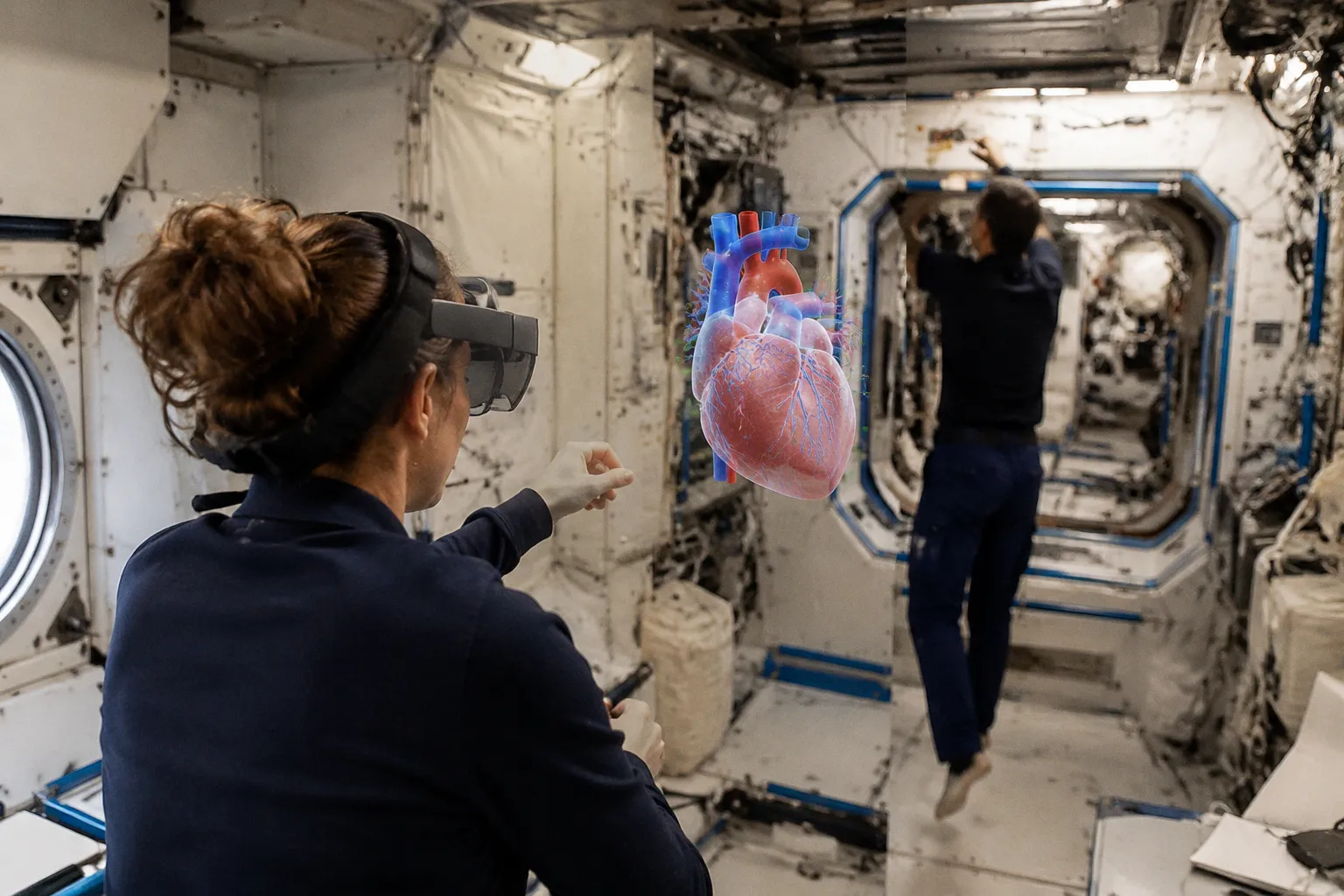
EchoFinder-2 and the Decoupling of Operator Skill from Image Acquisition
NASA flight engineers Jessica Meir and Jack Hathaway performed mutual venous scans using the EchoFinder-2 device, an ESA-supplied unit that overlays augmented reality guidance on the operator's probe trajectory and applies artificial intelligence to identify anatomical structures. The stated objective is independent crew health monitoring on missions transiting to the Moon or Mars without a trained sonographer on board. ESA flight engineer Sophie Adenot configured the hardware, connected it to a computer tablet, and installed a camera to track the vein study.
Data suggests that if a lay operator can achieve diagnostic-quality vascular imaging under microgravity with AR scaffolding, the principal limiting factor for point-of-care ultrasound in outpatient nutrition clinics — operator experience — becomes partially decoupled from the examination itself. No Earth-based replication data has been disclosed in the materials reviewed; the inference remains conditional on unpublished ground trials.
Genomic Surveillance and Vestibular Adaptation in Closed-Loop Habitats
Hathaway subsequently loaded bacterial samples into a portable DNA sequencer within the Harmony module, with Adenot retrieving a mini-cold bag to house the specimens. The investigative endpoint is characterization of resistance patterns in the space environment, with explicit reference to astronaut capacity to resolve infection. Microbial resistance in confined habitats has direct implications for clinical nutrition protocols, since antibiotic exposure in stressed or immunocompromised subjects can deplete the gut microbiota and compromise substrate bioavailability.
Two VR-based neurological studies ran in parallel. NASA flight engineer Chris Williams wore goggles that recorded eye movements under computerized visual stimuli as part of the CIPHER suite of 14 human research experiments. Roscosmos flight engineer Andrey Fedyaev underwent a comparable protocol, with electrodes measuring brain activity and tracking eye movement. The mechanism under examination is neurological adaptation to weightlessness, with downstream relevance to orthostatic tolerance and fluid-balance management — both of which intersect with refeeding protocols and hydration prescriptions in clinical nutrition.
Verdict and What to Monitor
The current evidence base supports the following conditional conclusions:
- AR-guided vascular imaging has reached crew-internal feasibility in microgravity; terrestrial translation to clinical nutrition screening is plausible but statistically unvalidated in the materials reviewed.
- On-orbit genomic sequencing can identify resistance loci, but the published protocol provides no quantitative data on resistance prevalence, transmission dynamics, or pharmacokinetic consequences.
- The vestibular datasets are exploratory and do not yet permit inference on Earth-applicable intervention thresholds.
Subsequent releases from the CIPHER suite, the antibiotics resistance study, and the June 30 spacewalk briefing — at which NASA will detail tools for a Canadarm2 wrist joint repair — warrant monitoring. The published materials contain no therapeutic claims; any extrapolation beyond the orbital test bed should be treated as hypothesis, not evidence.