Upcycled Food: What It Is and How It Works
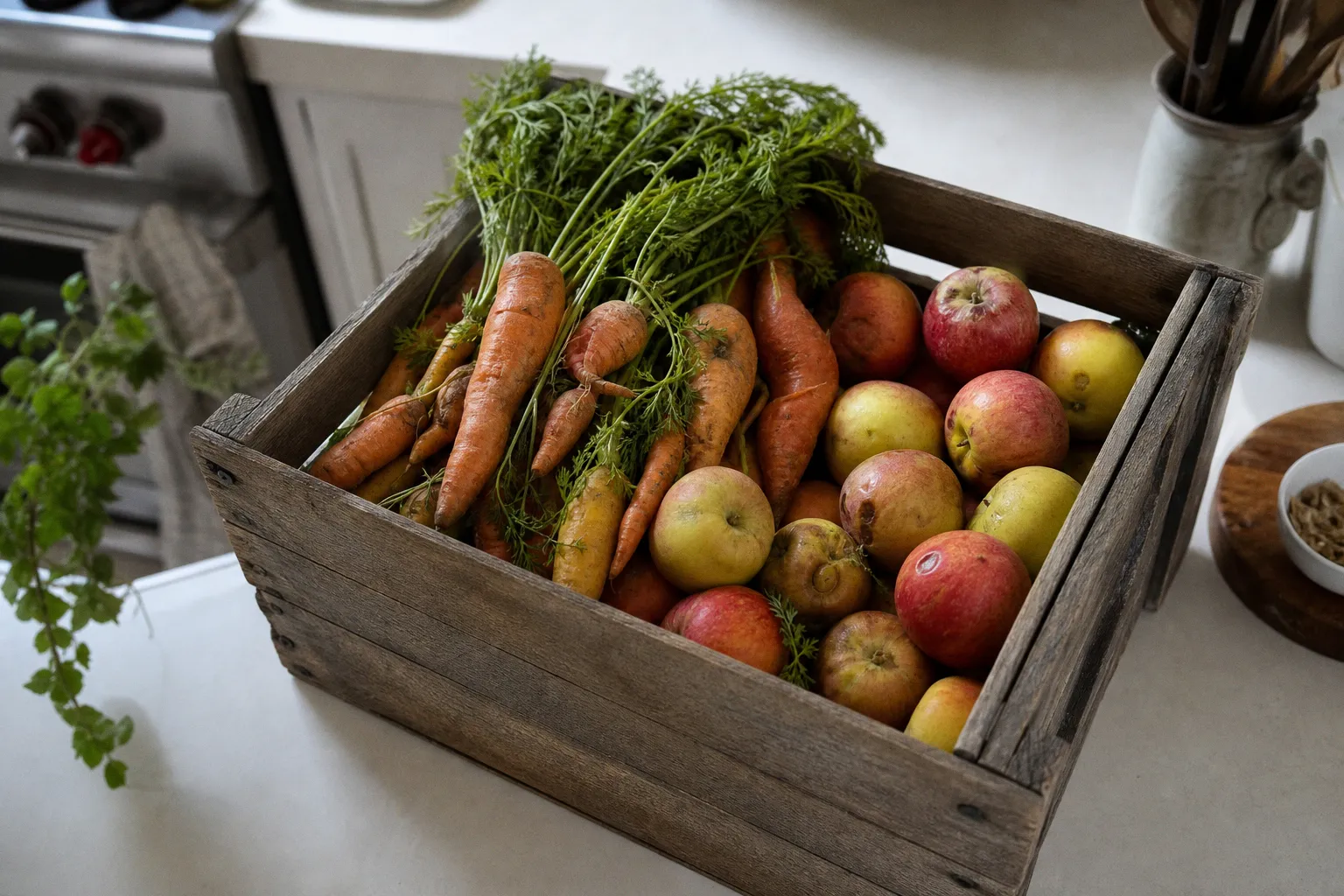
There's a quiet arithmetic to a wasted carrot: the water that watered it, the soil that fed it, the diesel that carried it, the hours someone spent harvesting it, all of it evaporating toward a landfill.
What "Upcycled Food" Actually Means
The Upcycled Food Association, the trade body that has done more than any other organization to give this category a shared language, offers a working definition worth sitting with for a moment. An upcycled food, in their framing, uses ingredients that otherwise would not have been consumed by humans; is procured and produced using a verifiable supply chain; and has a measurable positive impact on the environment.
Three pieces matter here, and I want to walk through them one at a time because they dissolve a lot of everyday confusion.
First, the "otherwise would not have been consumed" clause. This rules out perfectly edible surplus that simply didn't sell in time at a grocery store, and it rules out food donated to a food bank — though donation remains a generous and important practice in its own right. Upcycling, properly speaking, is for ingredients that by their nature were destined to leave the human food system. A brewer's spent grain. An apple peel. The milky runoff from a cheesemaking vat. Without intervention, these streams would have become cattle feed, compost, or effluent — useful, occasionally, but never part of a meal a person would actually eat.
Second, the "verifiable supply chain" requirement. Upcycling only earns its label when a third party can trace a pound of powder back to the brewery or bakery it came from. That traceability is the part that separates genuine upcycling from a hopeful label.
Third, the "positive environmental impact" anchor. The practice has to measurably reduce the footprint of the original food system — not merely feel virtuous.
Upcycling turns the byproducts we once considered refuse into ingredients worthy of the kitchen.
A quick note on what upcycled food is not. It is not a synonym for leftovers, imperfect produce, or food rescued at the markdown stage. Those categories have their own value and their own logic. Upcycling sits downstream of those ideas, working with parts of the food system that never had a culinary identity in the first place.
From Byproduct to Ingredient: Examples You Can Actually Find
When I walk through a brewery's back door and look at the steaming pile of spent grain left after the sugars have been extracted, I'm looking at the upcycling story in its most photographed form. A brewer in the past would pay a hauler to take that wet, fibrous material away — usually to a cattle farm or a landfill. Today, a separate bakery dries the grain, mills it, and sells it as a high-protein, high-fiber flour that ends up in crackers, pasta, granola bars, and even bread. The flour carries a flavor faintly reminiscent of the beer it came from — roasted, mildly sweet, a little earthy — and it has allowed small bakeries to build a regional identity out of what used to be somebody else's leftover.
Fruit peels follow a similar arc. The pomace left after orange juice has been pressed — wet, fragrant, easily forgotten — once carried almost no commercial value in the fresh-produce economy. It now drives a small industry of citrus-flavored snacks, essential oils, and pectin for jams and confectionery. Apple peels become a kind of natural sweetness in granolas and snack bars. Whey, the pale, faintly greenish liquid that drains off curds during cheesemaking, has quietly become one of the food industry's most prized streams. Once sprayed on fields as a low-value disposal solution, it is now filtered, dried, and sold as the protein backbone in everything from sports nutrition shakes to the broader category of functional ingredient formulations explored in discussions of microbiome health and metabolic balance. Bread crusts, unsold loaves, misshapen pasta, the chaff that falls off roasted coffee beans — each of these is a stream that upcyclers have learned to read like a second language.
| Source material | Traditional fate | Common upcycled form | Where it often appears |
|---|---|---|---|
| Spent grain from brewing | Cattle feed or landfill | Dried flour, protein concentrate | Crackers, pasta, granola, bread |
| Fruit peels and pomace | Disposal or low-grade feed | Pectin, citrus oils, dried snack pieces | Jams, snack bars, confectionery |
| Whey from cheesemaking | Field spray, effluent | Whey protein isolate, refined lactose | Protein powders, baked goods, beverages |
| Bread crusts and unsold loaves | Animal feed, disposal | Croutons, breadcrumbs, brewing adjunct | Soups, stuffings, beer |
| Coffee chaff and cascara | Compost, low-grade fuel | Flour, dried cascara, tea-style infusions | Baked goods, beverages |
A small but important distinction lives inside that table. Not every product that carries the word "upcycled" has cleared the verification bar. A cracker that contains some spent-grain flour may indeed be upcycled — but only if the flour can be traced back to a specific brewery whose grain, prior to the partnership, was being discarded. The label on the front of the package is doing a great deal of work, and that is precisely why a third-party certification matters.
How Supply Chain Verification Works
In 2021, the Upcycled Food Association launched Upcycled Certified, the world's first third-party certification program dedicated to upcycled food ingredients and products. The standard is not symbolic. To carry the mark, a product must contain a minimum of 10% upcycled content by weight, and the chain that produced that content must be auditable end to end.
In practice, this works like a passport. A brewery records what it sells to a flour mill. The flour mill records what it sells to a bakery. The bakery records what it sells to a retailer. Every handoff can be checked, and the certified product can answer the simple question: where did this material come from? For consumers, this is the meaningful difference between a marketplace full of aspirational labels and a marketplace with credible ones. If a product carries the Upcycled Certified mark, the supply chain has been walked. If it does not, the upcycling story on the package is, for now, a story the brand is telling about itself.
This is also where upcycled food separates itself from the looser vocabulary around "repurposed" or "rescued" foods. Repurposing is a perfectly good culinary practice, but it doesn't always meet the bar of taking something the system would otherwise have thrown away. Certification is the discipline that holds the word to its meaning.
Verifiable supply chains are the difference between upcycling as a movement and upcycling as a marketing claim.
The Environmental Ledger: What Upcycling Conserves
Imagine a head of broccoli that, for cosmetic reasons, never gets harvested. The water it absorbed, the fertilizer applied to its bed, the fuel burned by the tractor that prepared the soil, the labor of the person who walked the field to inspect it — none of those inputs vanish when the broccoli is left in the ground. They simply don't yield a meal. Upcycling works on the same logic, but at the level of the ingredient rather than the whole crop. When an apple peel becomes pectin instead of compost, the embedded water, land, and energy that produced that peel finally get to deliver a second human use.
Quantifying the savings precisely is tricky, and I'll be honest about that. Different upcycled products have different footprints, and the industry is still building a complete dataset. What is firmly established is the size of the underlying problem: roughly one-third of all food produced for human consumption is lost or wasted globally, and that waste contributes an estimated 8–10% of greenhouse gas emissions. Every ton of food diverted from waste is a ton of food for which the upstream inputs — water, land, energy — no longer have to be spent twice.
This is what people in the regenerative and circular economy spaces mean when they talk about closing the loop. A linear food system grows, eats, and throws away. A circular one grows, eats, recovers, and eats again. Upcycled food is a working expression of that shift, applied to the parts of the harvest and the parts of the manufacturing process that were always richer than the system gave them credit for.
Reading the Market — And Knowing What to Trust
Walk the snack aisle of a well-stocked grocery store in 2024 and you will see the vocabulary changing. Chip bags declare that their vegetables were "rescued." Protein bars advertise spent-grain flour. Juice bottles mention upcycled fruit. This is real progress, and it reflects a slow, patient shift in consumer awareness. The category has matured beyond the early stages, when upcycled food lived mostly in farmers' markets, food incubators, and a handful of mission-driven startups.
At the same time, the market is young enough that not every product on the shelf has earned its story. That is why the verification piece matters more than ever. As a general rule, the further a product gets from a simple, traceable ingredient (a spent-grain flour, a whey protein isolate), the more carefully I'd read the label. Blended products that include upcycled components alongside a long list of conventional ones can absolutely qualify for certification, but only when the upcycled portion meets the threshold and the chain can be documented.
A few patterns worth holding onto when you read a label:
- Look for the Upcycled Certified mark. It is the most reliable on-package signal that the claim has been verified by an outside party.
- Read the ingredient list. "Upcycled" flour, whey, or fruit should appear by name rather than as a vague generic.
- Be skeptical of buzzwords in isolation. "Sustainable," "eco-friendly," and "rescued" are not interchangeable with "upcycled," and they do not imply any specific chain-of-custody discipline.
- Trust ingredient specificity over storytelling. A clear statement like "made with brewers' spent grain from [named brewery]" carries more weight than a sentence about reducing waste in the abstract.
Practical Takeaway for the Reader
Upcycled food is not a niche curiosity for early adopters. It is a quietly operational answer to a problem the rest of the food system has barely begun to confront. When you choose an upcycled product — a cracker made from spent grain, a whey-based protein powder, a snack crafted from fruit peels — you are doing three things at once: you are giving a second life to an ingredient that would otherwise have been discarded, you are rewarding a producer who built a verifiable chain for that ingredient, and you are participating in the slow rewriting of how a food system can be circular rather than linear.
The thing I'd leave you with is this. The next time you stand in a grocery aisle considering two bars that look about the same, flip them both around. Read the ingredient list. Look for the certification mark. Ask yourself whether the upcycled content has a story you could trace, or whether the story ends at the front of the package. A food system built from what we already grow, rather than from the parts we always throw away, is not a distant idea. It is, increasingly, the bar in your hand.