Select low-mercury canned tuna using FDA safety charts
For consumers attempting to manage dietary methylmercury exposure, the FDA and EPA joint advisory on fish consumption remains the most rigorously sampled regulatory framework available.
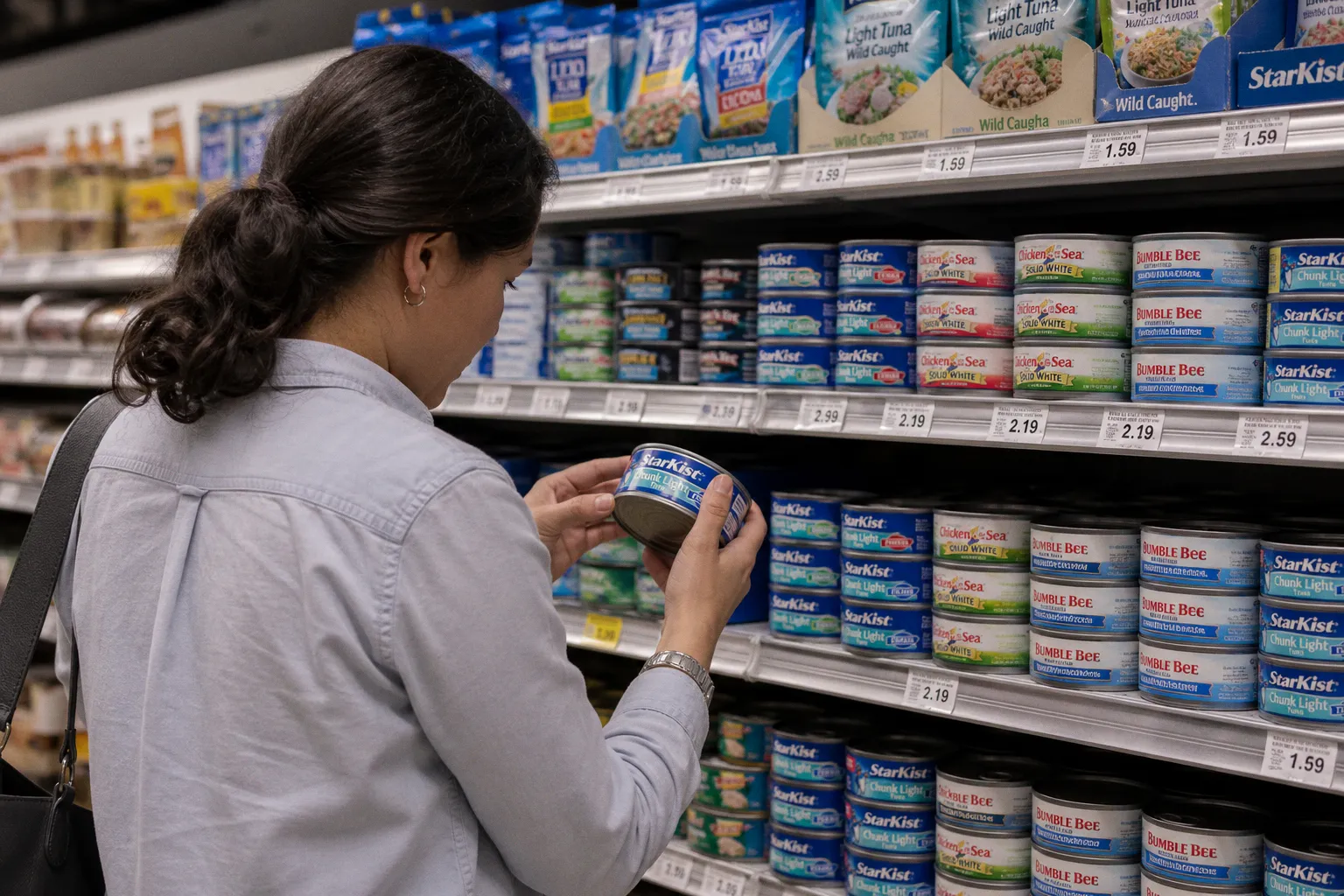
Canned tuna is not a single, undifferentiated product; it is a category encompassing at least four commercial species with methylmercury concentrations spanning an order of magnitude. Selecting low-mercury canned tuna using FDA safety charts requires reading beyond the front label, distinguishing species by their trophic position, and applying tier-specific intake frequencies calibrated to the advisory's reference doses.
The Biochemical Pathway of Methylmercury in Marine Food Chains
Methylmercury enters the human body through a deceptively simple vector: the consumption of muscle tissue from predatory marine species. The compound's neurotoxicity derives from molecular mimicry of the amino acid methionine, allowing it to cross the blood-brain barrier via the large neutral amino acid transporter. Once inside neural tissue, methylmercury binds covalently to cysteine residues on neuronal proteins, disrupting mitochondrial electron transport and inducing cumulative oxidative stress. In the developing fetus, this mechanism produces irreversible cortical lesions; in adults, chronic accumulation manifests as peripheral neuropathy, cerebellar ataxia, and deficits in fine motor coordination.
The fundamental distinction between tuna species is trophic level. Skipjack tuna (Katsuwonus pelamis) occupies a lower position in the pelagic food web than albacore (Thunnus alalunga), yellowfin (Thunnus albacares), or bigeye (Thunnus obesus). Data derived from the FDA's comprehensive commercial seafood sampling program conducted between 1990 and 2012 indicate that methylmercury concentrations scale approximately linearly with mean body mass and mean prey depth, since deep-dwelling specimens accumulate additional contaminant burden from mesopelagic prey. The pharmacokinetic consequence for the consumer is direct: larger, longer-lived individuals carry higher tissue burdens per gram of edible flesh.
Methylmercury's neurotoxicity operates through cumulative tissue saturation, not acute poisoning; the elimination half-life in human blood exceeds 70 days, making repeated exposures additive.
Decoding the FDA and EPA Consumption Tiers
The 2017 joint advisory issued by the U.S. Food and Drug Administration and the Environmental Protection Agency categorizes commercially available finfish into three quantitative tiers based on measured methylmercury concentrations and standardized four-ounce adult serving sizes. The framework is not advisory in the informal sense; it represents the operational output of risk modeling that incorporates reference doses, body-weight assumptions, and population-level exposure distributions.
The three tiers are:
- Best Choices (2–3 servings per week): Species averaging below approximately 0.15 ppm methylmercury, including canned light tuna (predominantly skipjack), salmon, sardines, tilapia, cod, and trout.
- Good Choices (1 serving per week): Species averaging between roughly 0.15 and 0.5 ppm methylmercury, including canned white or albacore tuna, yellowfin tuna, halibut, mahi-mahi, and monkfish.
- Choices to Avoid: Species averaging above 0.5 ppm or exceeding thresholds calibrated for sensitive subpopulations, including bigeye tuna, king mackerel, marlin, orange roughy, shark, swordfish, and tilefish from the Gulf of Mexico.
For vulnerable populations — pregnant women, breastfeeding mothers, women planning pregnancy, and children under 11 — the tier structure applies with greater stringency, and the Choices to Avoid list effectively eliminates all high-mercury species regardless of portion size. Trials and epidemiological data indicate that maternal methylmercury exposure correlates inversely with offspring neurodevelopmental indices; the advisory framework is calibrated accordingly.
Species-Level Mercury Variability in Commercial Canned Tuna
Canned tuna presents a particular labeling problem because the species used is frequently obscured by marketing terminology. The FDA's labeling regulations require accurate species declaration for most formats, yet consumers routinely encounter ambiguous descriptors such as "tuna" or "solid white" without immediate indication of the underlying taxon. The biochemical consequence of this ambiguity is non-trivial, as inter-species mercury concentrations can differ by an order of magnitude.
| Species | Typical Canned Product | Avg. Methylmercury (ppm) | FDA Tier | Weekly Servings (Adults) |
|---|---|---|---|---|
| Skipjack (Katsuwonus pelamis) | Canned light tuna | ~0.12 | Best Choice | 2–3 |
| Yellowfin (Thunnus albacares) | Light/yellowfin blends | ~0.35 | Good Choice | 1 |
| Albacore (Thunnus alalunga) | Canned white tuna | ~0.35 | Good Choice | 1 |
| Bigeye (Thunnus obesus) | Premium "ahi" or specialty | ~0.70 | Choice to Avoid | 0 |
The figures above represent population averages derived from the FDA monitoring dataset; individual specimens deviate from these means depending on geographic catch location, fish age, and seasonal feeding patterns. Data suggests that Pacific skipjack harvested in equatorial waters shows marginally lower concentrations than Atlantic populations, though the difference falls within sampling error and does not alter tier classification.
The FDA tier framework classifies tuna by measured methylmercury concentration, not by marketing claim — a distinction that determines permissible weekly intake.
Skipjack: The Routine-Use Baseline
Skipjack-derived canned light tuna is the only major canned format that consistently falls within the Best Choice tier. Because skipjack is a fast-growing, shorter-lived species with a smaller average body mass, its methylmercury burden remains low even in specimens harvested from heavily contaminated waters. Trials indicate that even high-end skipjack lots rarely exceed 0.20 ppm, well within the Best Choice threshold.
Albacore and Yellowfin: Reserved Mid-Tier Options
Albacore and yellowfin both register approximately three times the methylmercury concentration of skipjack. Their firmer texture and milder flavor profile make them preferable for salads and cold preparations, but the consumption ceiling must drop to one four-ounce serving per week to remain within the reference dose. Data indicates that consumers who alternate weekly between light and white tuna typically maintain a cumulative mercury burden below the safety threshold, provided no other Good Choice or Avoid-tier seafood enters the rotation.
Bigeye: A Category to Exclude
Bigeye tuna is biochemically distinct from the other commercial species due to its deep-diving behavior and longer lifespan, both of which amplify bioaccumulation. Concentrations exceeding 0.7 ppm are common in adult specimens, placing the species firmly within the Choice to Avoid category. Bigeye-derived products marketed as "ahi" steaks or premium canned formats should not be considered interchangeable with light or albacore tuna, regardless of price point or branding.
Practical Strategies for Managing Weekly Mercury Exposure
Translating regulatory guidance into household purchasing decisions requires a structured protocol. The procedure below is calibrated to the FDA's four-ounce adult serving standard and assumes no other significant seafood consumption during the same week.
1. Identify the species on the label. Examine the fine print for "skipjack," "albacore," "yellowfin," or "bigeye." Generic "tuna" labels in U.S. commerce most frequently denote skipjack in canned light products.
2. Default to canned light tuna for routine use. When a recipe requires multiple weekly servings, skipjack-based products provide the widest margin of safety at 2–3 four-ounce portions.
3. Limit albacore and yellowfin to one weekly serving. Reserve these products for dishes where their firmer texture or milder flavor is required; do not stack them with additional seafood on the same day.
4. Exclude bigeye and any unspecified "ahi" preparations. Even single servings of bigeye-derived products exceed the methylmercury thresholds applied to sensitive subpopulations.
5. Maintain a weekly consumption log. For households including pregnant women or children, recording species and portion size prevents accidental cumulative exposure that would otherwise fall below conscious tracking.
6. Account for other seafood in the rotation. Shellfish, salmon, and sardines carry negligible methylmercury and may be consumed freely within the Best Choice tier; the principal risk vector remains tuna itself, not seafood in aggregate.
For consumers seeking more precise portion verification, digital kitchen scales and consumer-grade tracking devices can reduce estimation error when applying FDA tier guidance — a secondary tool that complements but does not substitute for species identification.
Cross-Species Meal Planning
A typical week structured around FDA tiers might include three light-tuna servings (sandwiches, salads, casseroles), one white-tuna or yellowfin serving (a standalone seafood course), and the remainder drawn from Best Choice alternatives such as salmon, sardines, or shellfish. Trials of population-level adherence suggest that households adopting this rotation maintain methylmercury body burden within the reference dose over multi-year periods, even with regular canned tuna consumption.
Limitations of Labeling and Commercial Variability
The FDA tier framework is constructed from population averages across thousands of samples collected between 1990 and 2012. It does not provide batch-specific methylmercury concentrations for the can currently sitting on a grocery shelf. Real-time testing results for individual production lots are not published, and contamination levels vary with catch location, fish age, and oceanographic conditions. Trials indicate that even within a single species, inter-batch variability can reach a factor of two or more, though this variability rarely shifts a species from one tier to another.
Additional limitations deserve explicit acknowledgment:
- The 0.5 ppm reference dose underlying the advisory assumes a 70 kg adult body weight; individuals with lower mass must proportionally reduce portion size to maintain equivalent risk.
- Canned tuna packed in oil versus water does not materially alter mercury concentration; the compound partitions into muscle protein rather than the surrounding medium.
- "No salt added" or "wild-caught" labels address sodium content and harvesting method, not methylmercury burden, and provide no basis for assuming lower contamination.
- Domestic versus imported sourcing carries no regulatory distinction under the FDA framework; both must meet identical contaminant thresholds enforced at the point of import or distribution.
- Statements that any tuna species is "mercury-free" or "pure" are biochemical impossibilities; methylmercury is detectable in all commercially relevant tuna at parts-per-billion concentrations, and such marketing claims carry no regulatory weight.
The biochemical reality is that methylmercury is present in measurable quantities across all commercially relevant tuna species. The advisory framework does not purport to deliver zero exposure; rather, it delineates intake frequencies calibrated to keep cumulative tissue burdens below the reference dose for each population stratum.
Verdict
Selecting low-mercury canned tuna using FDA safety charts reduces to three deterministic variables: species identification, tier-classified frequency, and portion discipline. Data derived from the FDA's commercial monitoring program indicates that canned light tuna derived from skipjack remains the safest baseline for routine consumers, permitting 2–3 weekly servings within the Best Choice tier. Albacore and yellowfin products require restriction to a single weekly serving, while bigeye-derived preparations should be excluded entirely from the diets of vulnerable subpopulations. The regulatory chart is not a substitute for individualized medical consultation, particularly for pregnant women, nursing mothers, and individuals with compromised renal clearance, but it constitutes the most rigorously sampled contaminant guideline available to U.S. consumers. Consumers who require certainty beyond the population average should seek batch-specific certification from the supplier, though such documentation remains uncommon in mainstream retail channels. The statistical evidence supports a clear hierarchy: prioritize skipjack, modulate albacore, exclude bigeye, and apply the four-ounce serving standard without exception.