Verify gluten-free oat labels to avoid cross-contamination
You grab a bag of oats from the health food aisle. The label says "gluten-free" in clean, reassuring letters. You feel good about the purchase — especially if you're managing celiac disease or a serious gluten sensitivity.
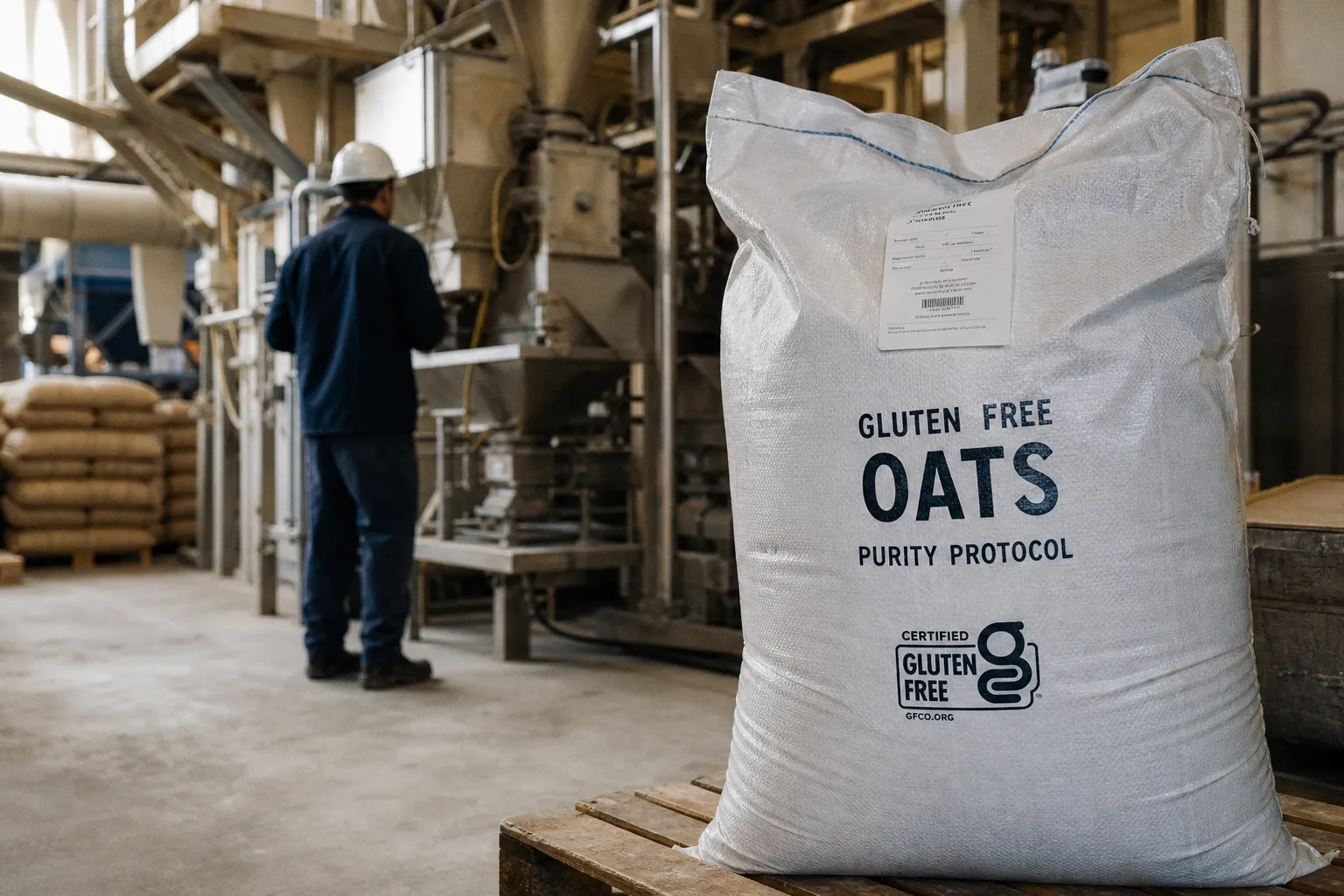
# How to Verify Gluten-Free Oat Labels for Safety
Oats are naturally gluten-free. That's not the problem. The problem is everything that happens to them between the field and your breakfast bowl — and the massive regulatory loophole that lets manufacturers slap a gluten-free label on products that haven't been rigorously tested for cross-contamination. If you're relying on those two words alone to protect your health, you're playing a game of supply-chain roulette. Let's fix that.
The Reality of Oat Contamination in the Supply Chain
Picture a grain elevator in the Midwest. Oats, wheat, barley, and rye roll through the same facilities, often on the same conveyor belts, stored in the same silos between harvests. This isn't some fringe scenario — it's standard agricultural infrastructure. The equipment gets cleaned between crops, sure, but "cleaned" in industrial grain processing means residual levels that would make your gastroenterologist wince.
Cross-contact with gluten-containing grains happens at every stage:
1. Field rotation and co-planting — Oat fields often sit adjacent to wheat or barley, and volunteer wheat plants sprout freely in oat fields the following season. Wind, birds, and shared harvesting equipment do the rest.
2. Transport and storage — Grain trucks, rail cars, and silos serve multiple crops without dedicated separation. A truck that hauled wheat yesterday hauls your oats today.
3. Milling and processing — Shared milling lines are the norm in conventional oat facilities. Flour dust from previous runs contaminates the next batch, even with cleaning protocols in place.
The result? Studies have found that conventional oats tested for gluten frequently exceed the 20 parts per million (ppm) threshold. Some batches have shown contamination levels of 200–800 ppm — ten to forty times the legal limit. And those numbers only represent the batches that actually got tested. The untested ones? Your guess is as good as the manufacturer's quality control budget.
Here's the gut punch: a "gluten-free" label on conventional oats tells you the manufacturer's intention. A third-party certification seal tells you someone actually checked.
This is why the distinction between "labeled gluten-free" and "certified gluten-free" matters so much. One is a marketing decision. The other is a verified supply chain claim backed by laboratory testing. If you have celiac disease, this difference isn't academic — it's intestinal.
Decoding the 20 ppm FDA Threshold vs. Third-Party Standards
Let's talk numbers, because this is where the regulatory framework gets interesting — and where most consumers stop paying attention.
The FDA finalized its gluten-free labeling rule in 2013. Under this standard, any product labeled "gluten-free" must contain fewer than 20 parts per million of gluten. This threshold wasn't pulled from thin air. It's based on clinical research showing that most individuals with celiac disease can tolerate trace amounts of gluten below this level without triggering a measurable immune response.
Here's what that means in practical terms: 20 ppm equals 20 milligrams of gluten per kilogram of food. Sounds negligible, right? But consider that a typical serving of oatmeal is around 40 grams. At the 20 ppm threshold, that serving could contain up to 0.8 mg of gluten. For someone eating oats daily, cumulative exposure adds up — and for the subset of celiac patients with heightened sensitivity, even sub-threshold levels can cause intestinal damage over time.
Now compare that to what third-party certifiers actually enforce:
| Standard | Gluten Threshold | Testing Requirements |
|---|---|---|
| FDA "Gluten-Free" Label | < 20 ppm | Self-reported by manufacturer; no mandatory batch testing |
| GFCO Certification | < 10 ppm | Independent lab testing of raw ingredients and finished products |
| Purity Protocol Oats | < 20 ppm (typically undetectable) | Dedicated facilities, seed stock, and harvest equipment — verified through chain of custody |
The Gluten-Free Certification Organization (GFCO) — the gold standard for celiac-safe products — doesn't just test. It audits the entire supply chain. Manufacturers seeking GFCO certification submit to facility inspections, ingredient traceability reviews, and ongoing batch testing. The result: a product that's not just below 20 ppm, but typically testing at 10 ppm or lower.
The gap between FDA labeling and GFCO certification isn't just technical. It's philosophical. The FDA approach trusts the manufacturer to self-regulate. The GFCO approach verifies independently. For anyone with a medical reason to avoid gluten, that difference defines the product's actual safety.
Identifying Purity Protocol Oats for High-Risk Consumers
If you have celiac disease — not a trendy gluten preference, but a diagnosed autoimmune condition — then Purity Protocol oats should be your default. And you need to understand what that label actually means, because it's not just marketing language.
Purity Protocol is an industry-developed supply chain standard that isolates oats from gluten-containing grains at every point of contact. Here's how it works in practice:
Step 1: Dedicated Seed Stock — The process starts with oat seed that's been verified free of wheat, barley, and rye contamination. Conventional oat seed lots frequently contain trace amounts of other grain seeds mixed in from prior harvests. Purity Protocol programs source seed from verified clean lots or grow their own.
Step 2: Isolated Growing Conditions — Fields used for Purity Protocol oats must have a clean history. That means no wheat, barley, or rye grown in the same field in recent crop rotations. Some programs require buffer zones between dedicated oat fields and neighboring conventional grain fields.
Step 3: Dedicated Harvest Equipment — Combines, grain carts, and trucks used for Purity Protocol harvests serve only gluten-free oat production during that season. No sharing with wheat harvest — period.
Step 4: Segregated Storage and Transport — Grain bins, rail cars, and transport vessels must be dedicated to gluten-free oat handling or rigorously cleaned and tested before use.
Step 5: Isolated Milling and Processing — The oats are processed in facilities that either handle only gluten-free products or maintain strict scheduling and testing protocols with dedicated equipment lines.
The result is a product with a verified chain of custody from field to package. Major Purity Protocol oat suppliers include companies like GF Harvest and Avena Foods, which have built their entire business model around this isolation process.
Why does this matter? Because testing alone has limitations. A finished product can test below 20 ppm and still pose a risk if contamination is unevenly distributed within a batch. Purity Protocol eliminates the contamination at the source rather than relying on end-product spot testing to catch it.
Purity Protocol doesn't test for the absence of gluten — it builds that absence into the supply chain. That's a fundamentally different level of protection.
When shopping, look for these telltale signs on packaging:
- "Certified Gluten-Free Oats" with a GFCO or similar seal — preferably backed by Purity Protocol sourcing.
- Explicit "Purity Protocol" language on the label or the manufacturer's website.
- Dedicated facility claims — if the company states their oats are processed in a gluten-free-only facility, that's a strong indicator.
What you don't want to see: vague language like "processed in a facility that also handles wheat" without any certification backing. That's the manufacturer telling you cross-contact is a known risk and they haven't fully mitigated it.
Navigating FALCPA and the Limitations of Allergen Labeling
Here's a regulatory quirk that catches even well-informed consumers off guard: gluten is not classified as a major allergen under U.S. federal law.
The Food Allergen Labeling and Consumer Protection Act (FALCPA), enacted in 2004, requires clear labeling for eight major allergens: milk, eggs, fish, shellfish, tree nuts, peanuts, wheat, and soybeans. Notice what's on that list — wheat. And notice what isn't — gluten.
This creates a strange regulatory situation. A manufacturer must declare wheat as an ingredient and identify it in the "Contains:" statement on packaging. But gluten itself — the protein composite found in wheat, barley, and rye — doesn't trigger the same mandatory disclosure requirements independently.
What does this mean for oat products specifically?
- Barley and rye are not major allergens under FALCPA. If your oats are contaminated with barley or rye through cross-contact, the manufacturer has no FALCPA obligation to disclose that risk in the allergen statement.
- "May contain wheat" warnings are voluntary. Advisory statements like "processed in a facility that also processes wheat" are not required by law. Some manufacturers include them as a liability courtesy; many don't.
- The gluten-free labeling rule fills a gap, but an imperfect one. The FDA's 2013 gluten-free rule gave manufacturers a framework for making gluten-free claims — but enforcement depends largely on post-market surveillance and consumer complaints, not pre-market testing mandates.
This regulatory patchwork means you cannot rely on allergen labeling alone to assess the gluten safety of oat products. The system wasn't designed with cross-contact gluten contamination in mind. It was designed for ingredient-level allergen disclosure, and gluten — as a cross-contact hazard in inherently gluten-free grains — falls through the cracks.
For international context, the EU and Canadian food safety systems handle this somewhat differently. Both require gluten labeling for products claiming to be gluten-free, and both recognize the 20 ppm threshold. But the enforcement mechanisms and third-party certification ecosystems vary significantly. If you're purchasing oats from international brands, verify which certification standard the product actually meets rather than assuming equivalence.
Evaluating Certification Seals for Reliable Quality Control
Walking down the oat aisle, you'll encounter a bewildering variety of certification logos, quality claims, and trust signals. Not all of them carry equal weight. Here's how to decode what you're actually looking at:
Tier 1: Highest Confidence
- GFCO Certified Gluten-Free (logo with the crossed-grain symbol) — The Gluten-Free Certification Organization is the most widely recognized third-party gluten-free certifier in North America. Their 10 ppm threshold, combined with supply chain audits and ongoing testing, makes this the benchmark for celiac-safe products.
- Certified by the Canadian Celiac Association (CCA) — Comparable rigor to GFCO, with particular relevance for products sold in the Canadian market.
Tier 2: Generally Reliable, Verify Details
- NSF Gluten-Free Certification — NSF International offers a gluten-free certification program that meets FDA requirements. Testing is independent, but the threshold aligns with the 20 ppm FDA standard rather than the stricter GFCO level.
- "Manufactured in a dedicated gluten-free facility" — A strong operational claim when true, but not independently verified unless backed by a third-party audit. Check whether the manufacturer publishes their testing protocols.
Tier 3: Low Confidence — Proceed with Caution
- "Gluten-free" with no certification seal — This is a self-declared claim. The manufacturer asserts compliance with FDA standards, but no independent body has verified it. For low-risk consumers (non-celiac gluten sensitivity), this may be acceptable. For celiac disease, it's insufficient.
- "Naturally gluten-free" — This is technically true for all oats. It's also meaningless as a safety claim. Wheat is "naturally" a plant; that doesn't make it safe for someone with a wheat allergy.
Here's a quick reference for your next grocery run:
1. Check for a third-party certification logo first. GFCO is the gold standard; NSF and CCA are solid alternatives.
2. Read the manufacturer's website, not just the label. Reputable brands publish detailed information about their sourcing, testing protocols, and facility status. If that information is missing or vague, consider it a red flag.
3. Verify Purity Protocol sourcing. The safest oats combine Purity Protocol supply chain management with third-party end-product testing. One without the other leaves gaps.
4. Watch for conflicting claims. If a product is labeled "gluten-free" but the allergen statement says "may contain wheat," take the warning seriously. The manufacturer is telling you about a known risk.
5. Don't trust "organic" as a proxy for gluten-free. Organic certification addresses pesticide use, not grain purity. Organic oats face the same cross-contamination risks as conventional ones.
The Bottom Line
You can't eyeball gluten contamination. You can't taste it. And you can't trust a "gluten-free" label to mean what you think it means without understanding the regulatory and certification landscape behind it.
Here's your action checklist before the next oat purchase:
- Prioritize third-party certified products — GFCO seal above all else for celiac management.
- Seek out Purity Protocol sourcing — it's the only supply chain standard that addresses contamination at its origin.
- Understand that FDA labeling is a floor, not a ceiling — the 20 ppm threshold is a minimum standard, not a guarantee of batch-level safety.
- Don't conflate "gluten-free" with "allergen-safe" — FALCPA doesn't classify gluten as a major allergen, so the regulatory safety net has gaps.
- Do your homework beyond the label — manufacturer transparency about testing, facilities, and sourcing is the real indicator of product integrity.
The oat aisle doesn't have to be a minefield. But treating every "gluten-free" claim as gospel? That's how you end up with a contaminated breakfast and a very bad week. Read the labels, verify the seals, and buy from brands that prove their claims — not just print them.
For more trend-savvy lifestyle coverage and practical guides across food, fashion, and home, check out TrendCrafted.