Allergen control plan: a step-by-step setup guide
Think a “may contain” label gets your facility off the hook? It does not. That little sentence is not a legal force field, not a cleaning program, and definitely not a substitute for knowing what is…
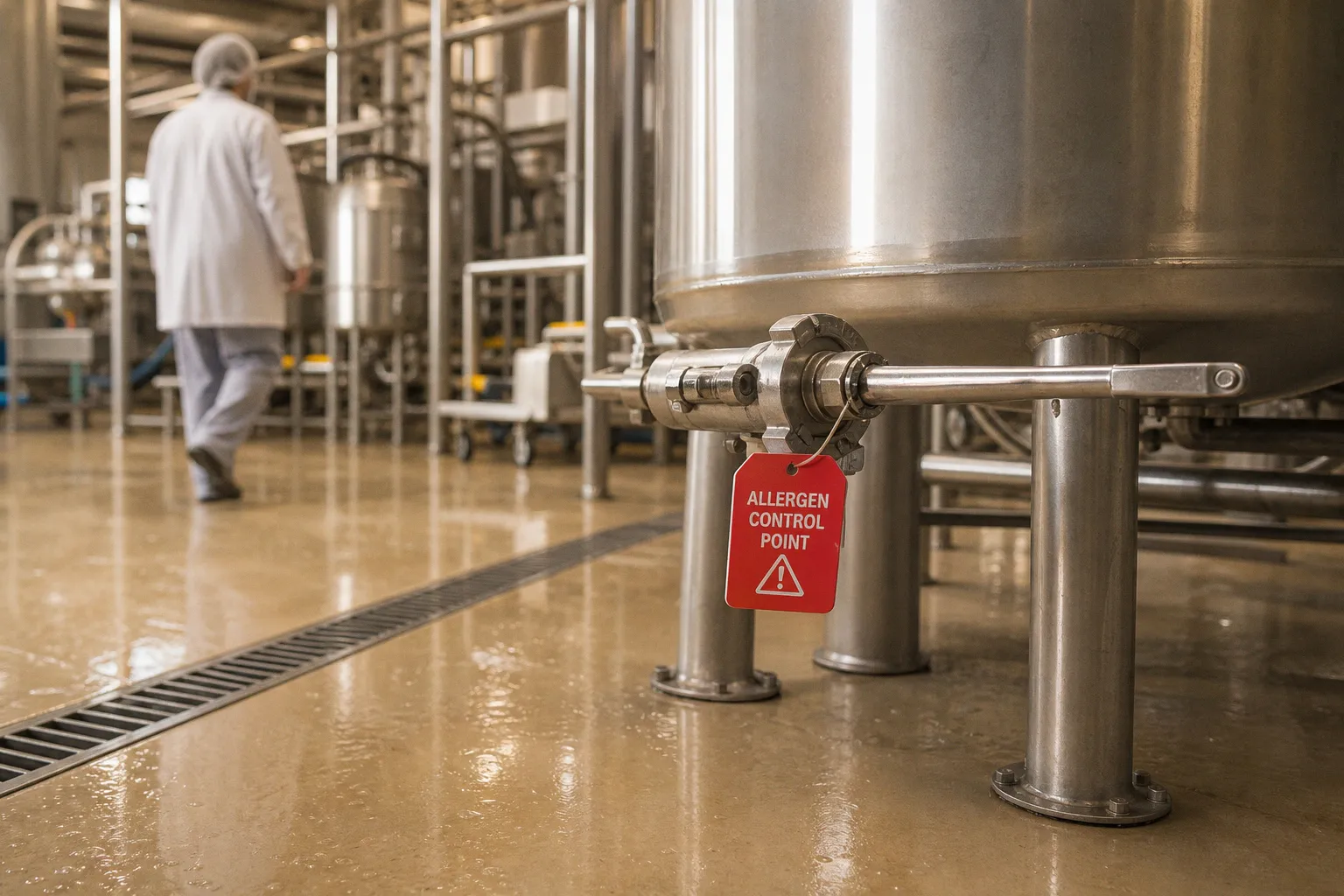
Think a “may contain” label gets your facility off the hook? It does not. That little sentence is not a legal force field, not a cleaning program, and definitely not a substitute for knowing what is happening on your line.
For FDA-regulated human-food facilities, allergen controls belong inside the written food safety plan under 21 CFR Part 117. The job has two halves: prevent allergen cross-contact and make sure the finished package declares allergens correctly. Miss either one and you can end up with a product that is unsafe, misbranded, recalled, or—if you really want a bad week—all three.
An allergen control plan template for a food facility is useful only if it forces you to answer operational questions. Which ingredients contain allergens? Where can they travel? What happens to rework? Who releases labels? How do you prove the controls worked? A template full of generic promises is paperwork cosplay.
Start with hazard analysis, not a prewritten template
The cleanest way to build a food allergen management plan is to start with the process flow you actually run—not the flowchart you wish you ran during an audit.
Under Part 117, food allergen controls are written procedures used to control cross-contact and ensure allergens are declared properly on labels. That means your hazard analysis must look at every relevant step where an allergen can enter, move, survive cleaning, or disappear from a label declaration.
For U.S. labeling purposes, the nine major food allergens are:
- Milk
- Egg
- Fish
- Crustacean shellfish
- Tree nuts
- Wheat
- Peanuts
- Soybeans
- Sesame
Sesame became the ninth major allergen on January 1, 2023. If your legacy ingredient files or label specifications still treat sesame as a footnote, they are already behind the line.
Build the analysis around your real materials and process steps. Not just the finished product name. A tomato sauce may look allergen-free until you inspect the seasoning blend, release agent, flavor carrier, or rework stream. “Spices” and “natural flavors” are not process controls. They are places where lazy documentation goes to hide.
A practical hazard analysis asks, at each step:
1. What allergen is present or could be introduced? Review every ingredient, processing aid, rework component, work-in-process container, and packaging material. Include supplier specifications and formulation changes.
2. How could it cross-contact another product? Look at shared receiving docks, scales, scoops, conveyors, fillers, utensils, dust collection, employee traffic, and compressed-air or dry-cleaning practices where relevant.
3. Can the allergen be removed or controlled later? Often, no. Heat may kill pathogens; it does not magically erase milk protein or sesame residue.
4. Could the package carry the wrong declaration? An allergen-free formula in the wrong film or carton is still a serious labeling failure.
5. Does this hazard require a preventive control? If it does, the control, monitoring, corrective action, verification, and records need to be written down.
This is where many facilities get cute and fail. They call allergens a “GMP issue” and stop there. Current Good Manufacturing Practice matters, but if your hazard analysis identifies allergen cross-contact or undeclared allergen risk requiring a preventive control, the plan needs actual preventive-control muscle.
An allergen is not “controlled” because someone knows it exists. It is controlled when the process makes a mix-up hard to cause and easy to catch.
Map ingredients by allergen status
Before writing procedures, build an ingredient and material register. Keep it boring, specific, and current. Boring records save exciting recalls.
| Material category | What to document | Common failure hiding there |
|---|---|---|
| Raw ingredients | Supplier, allergen profile, specification revision, storage location | A reformulated seasoning or flavor arrives with a new allergen |
| Rework and work-in-process | Source product, allergen status, permitted destination product | “Like into like” becomes “close enough into whatever is running” |
| Processing aids | Allergen content, application point, carryover potential | Release agents and lubricants get omitted from the review |
| Primary packaging | Approved artwork, ingredient statement, allergen declaration, version | Old film remains at the line after a changeover |
| Secondary packaging | Product code and SKU match | Correct pouch packed into the wrong carton |
Your plan should identify who owns the register and what triggers review: new supplier, formulation change, packaging redesign, co-manufacturer change, customer specification change, or a new product run. “We’ll update it annually” is not enough when a buyer changes an ingredient next Tuesday.
Prevent cross-contact with line controls that match reality
Preventing allergen cross-contact in manufacturing is not one control. It is a stack of controls. The right stack depends on your products, plant layout, equipment design, scheduling, and whether you run dry powders, sticky pastes, liquids, or all of the above because nobody in management likes simple operations.
FDA guidance examples include segregation of allergen-containing materials, production scheduling, cleaning and sanitizing after allergen runs, supplier and ingredient controls, process separation, rework controls, and label management. Those are tools, not a mandatory one-size-fits-all ritual.
Put physical separation where it does the most work
Segregation starts at receiving. If sesame-containing tahini, peanut pieces, milk powder, and soy protein all sit in one vague “allergen area,” your facility has not created control. It has created a future investigation.
Use storage practices that fit the material:
- Store allergen-containing ingredients in identified locations, with sealed and intact packaging.
- Keep damaged bags, leaking totes, and partial containers under defined handling rules. A split bag of milk powder is not a minor housekeeping event.
- Use clear status identification for opened materials and staged ingredients.
- Separate allergen and non-allergen processing routes where the process supports it.
- Control shared tools. Color coding can help, but colors do not discipline people. Written assignment, storage, and cleaning rules do.
- Design employee movement to reduce casual transfer between allergen and non-allergen areas, especially in powder handling.
Dry facilities need extra skepticism. Allergen residues can travel through dust, handling, and poorly controlled dry cleanup. A leaf blower, compressed air, or an enthusiastic brush can turn a contained residue into a plant-wide distribution program. Not ideal.
Use scheduling as a control, not an excuse
Production sequencing can reduce cross-contact exposure. Running non-allergen products before allergen-containing products is often sensible. Running products with fewer allergen profiles before products with more complex profiles can also reduce changeover burden.
But schedule alone is not a control plan. It only works when it is tied to defined changeover and sanitation procedures. A peanut-containing product run late in the day does not become harmless because it happened after lunch.
A workable scheduling rule specifies:
- Which allergen profiles can follow one another without a full allergen clean.
- Which transitions require cleaning, sanitation, inspection, or other validated controls.
- Who approves exceptions.
- What happens if production changes mid-shift.
- How the line status is documented before the next product starts.
If a supervisor can swap the schedule by text message and nobody re-evaluates the allergen implications, your beautiful schedule is just a suggestion with a clipboard.
Treat rework like an ingredient, because it is one
Rework is a repeat offender in allergen incidents. It looks like a yield-recovery opportunity until somebody adds cookie rework containing milk, egg, wheat, and soy into a product that declares only wheat. Then it becomes evidence.
The basic principle is “like into like.” Rework should go only into a product with an equivalent allergen profile, supported by controlled storage, handling, identification, and tracking. “Same flavor family” is not an allergen category. “It probably has the same stuff” is not traceability.
Your procedure should define:
- Which products may generate rework.
- The complete allergen profile of each rework stream.
- The exact destination products permitted to receive it.
- Container labeling and lot identification.
- Maximum hold conditions, if applicable to your process.
- Who authorizes use and how use is recorded.
Do not let unlabeled pails become a management system. They are not.
Make label control its own preventive-control system
Undeclared allergens are often a packaging-control failure wearing a food-safety costume. The formula may be correct. The allergen may be properly managed in the plant. But if a milk-containing cookie goes into packaging for a milk-free SKU, the consumer gets the wrong safety information. The regulator sees a misbranded product under FD&C Act section 403(w).
Label control needs more than proofreading artwork during product development. It needs operational controls at the line.
Build the label process from approval to reconciliation
Start with a master label specification for every SKU. It should connect the current formula, ingredient statement, allergen declaration, nutrition panel where applicable, artwork revision, packaging code, and approved customer or regulatory requirements.
Then control the physical labels and packaging materials.
A strong line procedure typically covers:
1. Pre-run verification. Confirm that the formula, packaging code, and allergen declaration match the scheduled product before materials reach the line.
2. Line clearance. Remove prior-run labels, film, cartons, inserts, and coding materials. “Mostly removed” is how mixed packaging survives.
3. Startup inspection. Check the first acceptable packages against the approved specification.
4. In-process checks. Verify packaging and code accuracy at defined intervals and after interruptions, roll changes, jams, or operator changes.
5. End-of-run reconciliation. Account for unused packaging and investigate discrepancies. Missing film does not teleport.
6. Controlled disposition. Quarantine and assess any product packaged during a mismatch, uncertain changeover, or failed check.
The label declaration must reflect the actual product in the package. That sounds painfully obvious because it is. Yet facilities still separate formula control from artwork control, then act surprised when the two systems disagree.
“May contain” is not a cleanup strategy
Precautionary allergen labeling—statements such as “may contain”—cannot replace compliance with CGMPs or applicable preventive controls. FDA’s position is straightforward: such statements may be used only when they are truthful and not misleading.
In plain English: you do not get to skip segregation, cleaning, labeling controls, or process discipline and then print “may contain” as a liability blanket.
There is also no single generally applicable U.S. FDA threshold in parts per million that tells every facility when cross-contact is acceptable or when a precautionary statement is warranted. Anyone selling you one universal number for every food, every allergen, every process, and every consumer is selling certainty they do not have.
Write monitoring that tells people what to do
A HACCP allergen control checklist can be useful, but a checkbox alone does not satisfy a preventive-control system. Under 21 CFR 117.145, monitoring procedures need to say how the control is monitored and how often.
“Monitor sanitation” is corporate fog. Monitor what? By whom? At what point? Against which acceptance criteria? Where is the record?
For every allergen preventive control, write five things:
- Control: The action that prevents or significantly minimizes the hazard. Example: approved label verification before startup.
- Monitoring: The observation or measurement that confirms the control is being applied. Example: operator compares packaging SKU and allergen declaration to the production order.
- Frequency: Every startup, every packaging roll change, every defined interval, or another frequency justified by the process.
- Corrective action: The action when a failure occurs. Example: stop the line, place affected product on hold, identify scope, reconcile packaging, and determine disposition.
- Verification: The activity that confirms the system works. Example: record review, internal audit, label-specification review, or appropriate sanitation verification.
The precise monitoring frequency and test method must fit the facility’s hazard analysis. FDA does not prescribe one universal allergen swab type, pass/fail value, or testing schedule for every plant. That is inconvenient if you wanted a magic spreadsheet. It is also reality.
Separate correction from corrective action
Not every issue needs a full-scale investigation. A single misplaced scoop caught before use may be corrected by removing it, cleaning it as required, and documenting the event. A confirmed wrong-label run, unexplained positive allergen finding, or breakdown in a preventive control may require broader corrective action.
The distinction matters because serious failures need serious follow-through:
- Hold potentially affected product.
- Determine the lot range and distribution status.
- Investigate the root cause, not just the last person who touched the line.
- Restore control before release or restart.
- Evaluate whether the food safety plan, training, supplier controls, sanitation procedure, or label controls need revision.
- Keep records that make sense to someone who was not in the building that day.
Under 21 CFR 117.150, corrective actions and corrections are part of the system. If your records show the same “operator error” six times, you do not have six operator errors. You have a weak process dressed up as accountability.
The record is not there to prove somebody signed a form. It is there to prove the hazard was controlled when nobody was watching.
Verify cleaning without pretending every surface is identical
Allergen cleaning is where plans become either too vague or absurdly rigid. Neither helps.
A belt with seams, a hard-to-reach filler nozzle, a shared ribbon blender, and a smooth stainless-steel table do not present the same residue risk. Your sanitation procedure must address the equipment and the allergen matrix you actually handle.
For wet cleaning, the procedure may involve cleaning and sanitizing equipment after allergen-containing products, followed by inspection and appropriate verification. For dry operations, the method may rely on controlled dry cleanup, disassembly where needed, vacuuming, tool controls, and visual inspection. The point is not to worship a particular method. The point is to show that residues are removed or controlled before the next susceptible product runs.
Verification can include:
- Pre-operational visual inspection of product-contact and adjacent surfaces.
- Review of sanitation records.
- Allergen-specific testing where it is appropriate to the product, equipment, and risk.
- Periodic assessment of difficult equipment zones and changeover performance.
- Trend review when failures, complaints, or unusual results occur.
Do not mistake a negative swab for universal proof of safety. Sampling covers a location, a moment, and a method. It can support your program. It cannot replace a sound cleaning design, trained sanitation crew, and equipment that can actually be cleaned.
Build recall readiness before the phone rings
If your hazard analysis identifies a hazard requiring a preventive control, FDA expects a written recall plan. For allergen hazards, that is not theoretical. An undeclared allergen can trigger a fast-moving recall because the product may present a serious risk to sensitive consumers.
The recall plan must cover four operational elements:
| Recall element | What your plan needs to answer |
|---|---|
| Consignee notification | Who receives notice, how quickly, and how customer contacts are maintained |
| Public notification, when necessary | Who decides, who approves the message, and how external communication is managed |
| Effectiveness checks | How you confirm consignees received and acted on the notice |
| Product disposition | How returned, recovered, or held product is identified, controlled, and disposed of |
Your allergen control plan should connect directly to traceability. Can you identify the ingredient lot, production dates, packaging used, rework involved, and customers shipped? Can you do it without three people digging through emails and a retired supervisor’s notebook?
Run a mock recall that includes an allergen scenario. Use a realistic trigger: a supplier specification change, an incorrect packaging roll, a rework mistake, or a failed label check. Test how quickly the team can define the affected product and contact the right parties. The exercise is not a performance. It is a stress test for your records.
Bottom line: the checklist that earns its paperwork
A compliant allergen control plan is not a laminated poster saying “allergen awareness.” It is a working operating system for ingredients, equipment, people, labels, and records.
Before you call the plan finished, make sure it does all of this:
- Identifies allergen hazards at each relevant process step.
- Covers all nine major U.S. allergens where they apply to your materials and products.
- Controls cross-contact through risk-based storage, handling, scheduling, cleaning, process separation, and rework practices.
- Uses “like into like” rules for rework, with clear identification and traceability.
- Treats label approval, line clearance, startup checks, in-process checks, and reconciliation as real controls.
- Defines monitoring methods and frequencies instead of writing vague promises.
- Documents corrections, corrective actions, verification, and implementation.
- Includes recall procedures for notification, effectiveness checks, and product disposition.
- Gets reviewed whenever formulas, suppliers, equipment, packaging, or processes change.
The corporate noise says food safety plans are documentation burdens. That is half true: bad plans are. A good allergen control plan makes the right action obvious at the moment it matters—before the wrong ingredient, wrong residue, or wrong label reaches a consumer.