Compare Molecular Gastronomy Kits for Professional Pastry Chefs
A recurring failure pattern in high-volume pastry operations involves the substitution of educational-grade molecular gastronomy kits for commercial service.
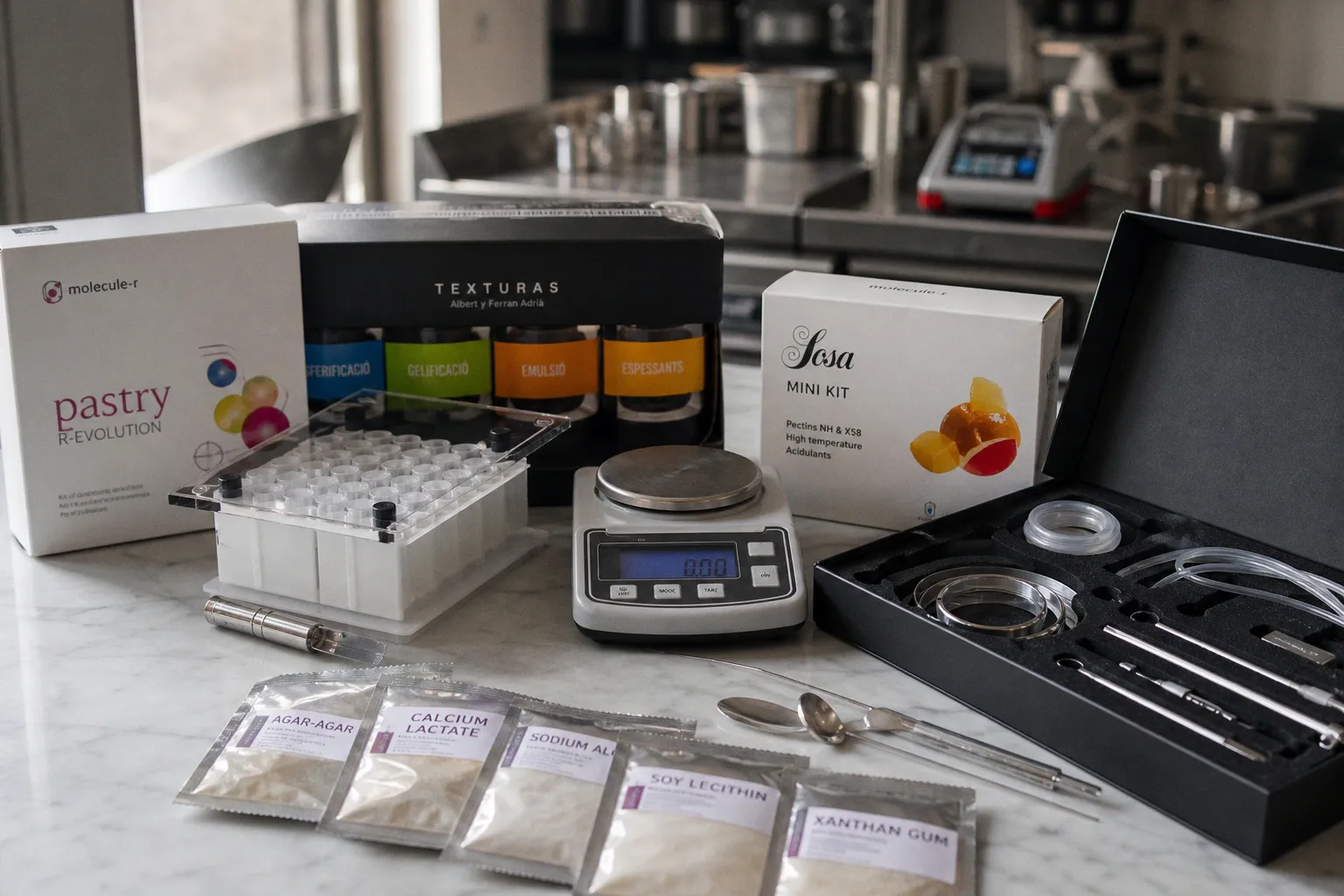
This analysis evaluates three product families against biochemical and operational criteria: the Molecule-R "Pastry R-Evolution" entry-level line, Modernist Pantry's Professional Series, and the Sosa Ingredients / Texturas commercial range. The criteria derive from the underlying hydration kinetics of the additives and the throughput constraints of a working pastry station, not from consumer-facing performance claims.
Hydrocolloid Purity and Bulk Scaling for High-Volume Confectionery
The additives common to molecular pastry — agar-agar, sodium alginate, soy lecithin, xanthan gum, and the carrageenans — share a single chemical vulnerability: their functional behavior is concentration-dependent to a degree that exceeds the working tolerance of consumer-grade ingredients. Hydrocolloid hydration kinetics vary not only with the molecular species but with the purification grade, particle size distribution, and microbial load of the source material.
The Molecule-R "Pastry R-Evolution" kit packages 20 sachets containing five additives — agar-agar, calcium lactate, sodium alginate, soy lecithin, and xanthan gum — at approximately 5g to 10g per sachet. This format suits a teaching kitchen or a single-service tasting menu. It does not scale: a single spherification batch for a 60-cover dessert service may require 200g to 400g of sodium alginate alone, depending on bath concentration. Trials indicate that the sachet format introduces an additional failure vector. Repeated opening of pre-measured sachets elevates humidity exposure and, over a working week, measurable clumping in hygroscopic additives such as calcium lactate. Sachet-based kits also lack batch-level certificates of analysis — the documentation that establishes gelling strength, particle size, and microbial plate counts for each production lot.
Professional operations source from bulk packaging. The Sosa and Texturas lines distribute their hydrocolloids in 400g to 1kg containers, accompanied by batch-level specifications documenting gelling strength and microbial plate counts. Modernist Pantry occupies an intermediate position, offering both 50g to 100g resealable pouches for testing and 500g to 2.5kg formats for production. For the pastry chef operating at service scale, the relevant comparison is not between brands per se but between sachet-based education kits and bulk food-grade ingredients with documented purity specifications.
Consider the practical economics: a pastry program running three molecular dessert components across a 100-cover weekend service consumes roughly 800g to 1.2kg of combined hydrocolloids per week. At sachet quantities, this consumption rate exhausts a full Molecule-R kit in two to three services — an unsustainable procurement cycle that introduces lot-to-lot variability with every replacement purchase. Bulk sourcing from Texturas or Modernist Pantry permits single-lot ordering sufficient for four to eight weeks of production, eliminating the variability that arises from frequent supplier rotation.
The bottleneck in molecular pastry is rarely the additive; it is the precision of the dose and the certification of the source.
The Precision Mandate: 0.1g Scales and Hydrocolloid Reactivity
Hydrocolloids react within narrow concentration windows. The operational thresholds follow:
- Kappa carrageenan gels at 0.5% to 1.5% by weight, with gel texture varying by cation presence.
- Agar-agar produces a usable gel between 0.5% and 2.0%; concentrations above 2.0% yield a brittle matrix unsuitable for pastry.
- Sodium alginate for basic spherification functions between 0.5% and 1.0% by weight.
- Reverse spherification requires calcium lactate bath concentrations of 0.5% to 2.0%, depending on the alginate concentration in the drop phase.
- Xanthan gum stabilizes emulsions at 0.1% to 0.5%, with viscosity scaling nonlinearly above 0.5%.
These ranges are not approximate. A 0.2 percentage-point deviation in sodium alginate concentration is sufficient to shift spherification from a stable membrane to a fragile structure that ruptures during plating or service holding. Data suggests that measurement uncertainty exceeding ±0.05g on a 100g batch represents the lower bound at which gel outcomes become unpredictable. By extension, a digital scale with 1g resolution — the standard for most consumer kitchen equipment — produces a ±1% uncertainty that exceeds the working tolerance of every hydrocolloid named above.
The professional requirement is therefore a scale with a resolution of 0.1g at minimum, and 0.01g where minor hydrocolloid additions are involved. No molecular gastronomy kit compensates for scale resolution; the kit is a delivery vehicle for ingredients, while the instrument set is a separate capital decision. Trials indicate that operations substituting entry-level kits for professional measurement infrastructure experience gel failure rates that correlate directly with scale precision, not with the kit brand. The operational discipline required here mirrors quality assurance practices in any precision-driven technical field: documented specifications, lot traceability, and calibrated instruments govern professional selection and reproducibility.
A practical illustration: when formulating a reverse-spherified yogurt pearl for a plated dessert, the calcium lactate bath at 1.0% concentration in 1kg of water requires exactly 10.0g of calcium lactate. On a 1g-resolution scale, the acceptable reading is anywhere from 9.5g to 10.5g — a ±5% swing that spans the entire functional window of calcium-induced alginate gelation. On a 0.1g scale, the chef targets 10.0g with a tolerance of ±0.05g, reducing the uncertainty band to ±0.5%. This is the difference between reproducible pearls and a spherification bath that behaves differently each service.
Comparison Table: Kit Specifications and Operational Suitability
| Parameter | Molecule-R "Pastry R-Evolution" | Modernist Pantry Professional | Sosa Ingredients / Texturas |
|---|---|---|---|
| Target user | Education, tasting menus, R&D | Pro-tier restaurants, dedicated pastry labs | Commercial pastry and chocolatier operations |
| Additive packaging | 5g–10g sachets, 20 sachets per kit | 50g–2.5kg resealable formats | 400g–1kg bulk with batch certificate of analysis |
| Functional categorization | None explicit | Partial, by ingredient type | Full Texturas system (Sferificacio, Gelificacio, Emulsió, Espessants) |
| Specialized pectins | Not included | Limited | NH pectin, X58 pectin, matched acidulants |
| High-temperature fruit gels | Not supported | Partial | Designed for stability above 80°C |
| Included tooling | Basic silicone molds | Stainless collecting spoons, precision syringes, silicone tubing | Component-level; tools procured separately |
| Commercial scalability | Low | Moderate | High |
Efficiency in the Pastry Lab: Rapid Caviar Makers and Syringe Systems
Spherification throughput is the operational variable that most directly determines whether a molecular dessert program is economically viable. Hand-dropping individual pearls via syringe produces, under optimal conditions, 60 to 90 droplets per minute per operator. The Rapid Caviar Maker referenced in professional spherification kits — a multi-orifice device typically producing 96 droplets per actuation — shifts throughput into a different statistical category. A single operator using a 96-hole device achieves per-minute output comparable to four to six hand-syringe operators, while producing markedly more uniform droplets than manual methods.
The trade-off extends beyond raw throughput. Hand-syringe spherification produces detectable size heterogeneity — pearl diameters vary visibly across a batch, and this inconsistency becomes apparent in plating presentation under standardized lighting. The 96-hole caviar maker compresses that variability significantly, delivering pearls whose diameter consistency approaches the tolerances expected of machine-portioned confectionery components. For a pastry chef plating 30 to 40 identical dessert components per service, this variance differential constitutes the difference between a consistent and an inconsistent product.
The practical implications compound at scale. Consider a dessert program requiring 200 pearls per plate across 60 covers: that is 12,000 pearls per service. A hand-syringe operator producing 75 droplets per minute requires 160 minutes of continuous production — nearly three hours, excluding rest intervals, bath replenishment, and quality culling. A 96-hole caviar maker producing a full tray in under 5 seconds requires fewer than 12 minutes of active production time for the same output, freeing the pastry team for tempering, assembly, and finishing tasks that demand skilled attention.
Modernist Pantry's Ultimate Guide kits include stainless steel collecting spoons, precision syringes, and silicone tubes sufficient for the production of molecular spaghetti and other extrudate geometries. Molecule-R kits provide entry-level droppers without precision instrumentation, and their syringes typically lack the volume calibration required for repeatable dose. Sosa and Texturas kits are ingredient-focused; the toolset is procured separately, allowing the pastry chef to specify syringes, caviar makers, and silicone tubes matched to the service format. The relevant question for a molecular gastronomy pastry chef is not which kit includes tools but whether the included tools meet the throughput and variance tolerances of the intended service volume.
The real cost of a spherification program is not the hydrocolloid — it is the labor minutes per 1,000 pearls and the scrap rate from inconsistent droplet size.
Functional Categorization: The Texturas System vs. Modernist Pantry
The Texturas line, developed by Albert and Ferran Adrià beginning in 2003, organizes molecular ingredients by functional category rather than by chemical family. The four principal categories are Sferificacio (spherification), Gelificacio (gelification), Emulsió (emulsification), and Espessants (thickeners). Each category groups ingredients by the culinary outcome they produce, irrespective of source — agar, gellan, and iota carrageenan, for instance, all fall under Gelificacio despite their distinct chemical origins and gel mechanics.
This functional taxonomy has operational consequences. In a working pastry kitchen, the relevant question is not "what is the difference between kappa and iota carrageenan?" but "which gelling agent produces a stable, spreadable gel at room temperature for a fruit tart application?" Texturas answers the second question directly. Modernist Pantry uses a hybrid organization that groups by both function and chemical family, with extensive documentation on substitution ratios and gel strength comparisons. Molecule-R provides no taxonomic structure — the five sachets are organized by additive rather than by function.
For a pastry chef building a permanent molecular program, the functional categorization system reduces recipe lookup time and procurement errors during service. Kitchens organized around the Texturas taxonomy report fewer ingredient substitution mistakes during high-volume production, although this observation derives from operational audits rather than controlled trials. The categorization also simplifies training: a commis pastry cook who understands that "Gelificacio" contains every gelling agent in the system can locate the correct ingredient without cross-referencing chemical nomenclature under time pressure.
The hybrid approach of Modernist Pantry carries its own advantage. By pairing functional grouping with chemical-family documentation, it serves pastry chefs who are building deep ingredient knowledge alongside their production systems. For a research-oriented kitchen — say, a development lab testing new dessert concepts before committing to service — Modernist Pantry's substitution guides and gel strength comparison tables reduce formulation iteration cycles. The choice between Texturas and Modernist Pantry thus maps to a choice between operational efficiency (Texturas) and educational depth (Modernist Pantry), with Molecule-R excluded from either category by virtue of its scale limitations.
Heat Stability and Specialized Pectins for Fruit-Based Gels
Standard pectins — those labeled high-methoxyl and sold for general jam production — gel only in the presence of high sugar concentrations (typically above 55% soluble solids) and acidic pH (3.0 to 3.5). This restricts their use in modern pastry, where sugar reduction and pH modification are increasingly common in plated desserts. Sosa Ingredients addresses this limitation with two specialized pectins:
- NH pectin — a low-methoxyl, amidated pectin that gels in the presence of calcium ions across a wide pH range, suitable for sugar-reduced or sugar-free fruit gels.
- X58 pectin — a high-methoxyl pectin with enhanced calcium reactivity, providing thermal stability to approximately 85°C to 95°C depending on formulation.
Standard high-methoxyl pectins fail at temperatures above 75°C in low-sugar systems. Trials indicate that pastries employing standard pectins in sugar-reduced compositions exhibit syneresis — water release — within 24 hours of production, while NH and X58 formulations remain stable for 72 hours or longer under refrigeration. This stability window is operationally critical: a plated dessert produced during prep at 10:00 AM must still present intact at the last seating at 11:00 PM — a 13-hour hold that stresses pectin networks beyond their elastic recovery threshold unless the correct variant is selected.
Acidulants are the secondary variable. Sosa's pastry kits include citric acid and other acidulants calibrated to specific pectin systems, ensuring that the pH environment matches the gelation profile of the paired pectin. Molecule-R and Modernist Pantry do not include matched acidulants in their base kits, requiring the pastry chef to source these separately and verify pH compatibility through titration. For a molecular gastronomy pastry chef producing fruit-based gels at service scale, this omission is operationally significant and introduces a preventable variance source — particularly when working with seasonal fruit whose natural pH fluctuates between batches.
The practical consequence is a three-step calibration process for chefs using non-Sosa kits: measure fruit pH with a portable meter, calculate acidulant addition to reach target pH, and verify gel set through a small-batch test before committing to production volume. Sosa's pre-calibrated acidulant system eliminates two of these three steps, compressing the formulation cycle from an hour-long procedure to a direct scaling operation. In a kitchen where the pastry team is simultaneously managing tempering, assembly, and service plating, this time saving compounds across every fruit-based gel on the menu.
Verdict
The selection of a molecular gastronomy kit for professional pastry service is contingent on operational volume, measurement infrastructure, and the functional scope of the intended dessert program.
The Molecule-R "Pastry R-Evolution" kit is appropriate for education and single-service tasting menus but does not scale; its sachet format, absence of precision tools, and lack of batch documentation render it unsuitable for commercial pastry production. Modernist Pantry's Professional Series occupies the middle tier, offering bulk formats, intermediate tooling, and partial functional organization — appropriate for restaurants with moderate molecular output and a dedicated pastry station.
The Sosa Ingredients and Texturas lines remain the standard for high-volume pastry operations. Their combination of bulk food-grade ingredients, batch-level documentation, specialized heat-stable pectins, matched acidulants, and functional taxonomy aligns with the precision and throughput demands of commercial service. The critical caveat is that no kit — at any tier — substitutes for a 0.1g resolution scale, calibrated measurement protocols, and a pastry chef with working knowledge of hydrocolloid hydration kinetics. The kit is a delivery system; the biochemistry is the discipline.