Compare agar-agar and gelatin for heat-stable fruit gels
Agar-agar and gelatin represent two fundamentally distinct gelling biopolymers, and their divergent molecular architectures dictate their behavior in heat-exposed fruit preparations.
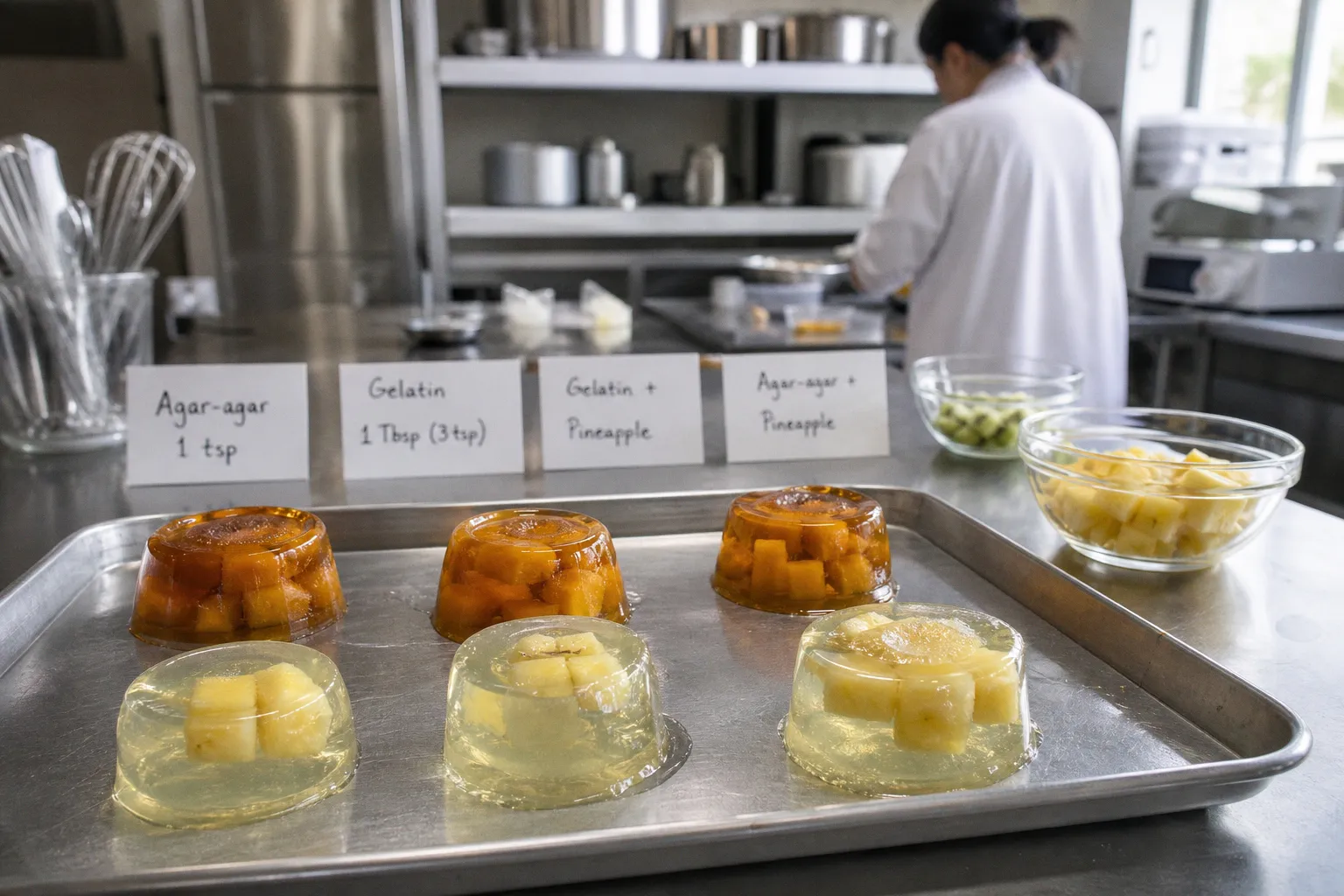
# Comparing Agar-Agar and Gelatin for Heat-Stable Fruit Gels
The core divergence lies in chemistry. Gelatin is an animal-derived protein hydrolyzed from collagen; its triple-helix structure denatures and re-forms a thermo-reversible gel that melts near body temperature. Agar-agar, by contrast, is a seaweed-extracted heteropolysaccharide (primarily agarose and agaropectin) whose gel network is held together by hydrogen-bonded double helices that require temperatures far exceeding ambient conditions to dissociate. These are not interchangeable ingredients. They are two distinct solutions to the same culinary problem, each with its own thermodynamic envelope.
The selection of a gelling agent for fruit applications is governed by the molecular class of the polymer, not by interchangeable volume substitutions.
Molecular Architecture and Thermal Behavior
The thermal hysteresis exhibited by agar-agar is the single most consequential property for heat-stable applications. Agar solutions set at approximately 32–45°C, yet the resulting gel does not re-melt until it reaches 85–95°C. This gap between setting and melting temperatures means that an agar-based fruit gel will maintain its structural integrity on a warm buffet table, under heat lamps, or during transport in non-refrigerated conditions, provided ambient temperatures remain below 85°C. Data from food technology literature confirms this behavior across multiple agar grades and concentrations.
Gelatin operates within a far narrower thermal window. It dissolves in liquids warmed to approximately 50°C after a brief bloom in cold water, and it solidifies at roughly 15–25°C depending on concentration and Bloom strength. The resulting gel, however, begins to soften at 28–30°C and fully liquefies by 32–35°C, precisely the range of room and body temperature. For fruit gels intended to be served cool or cold, this is acceptable. For any application involving prolonged exposure to warmth, gelatin is structurally unreliable.
This thermal asymmetry is not a minor consideration. It is the determining factor in selection when the final product must remain gelled in non-refrigerated service conditions.
Biochemical Resistance: Proteases and Fresh Fruit
A second layer of differentiation emerges from enzymatic vulnerability. Gelatin, being a protein, is susceptible to cleavage by proteolytic enzymes, specifically bromelain (found in pineapple), papain (papaya), actinidin (kiwi), and ficin (fig). When raw or minimally heated fruit containing these enzymes is incorporated into a gelatin-based gel, the protease activity degrades the protein matrix, preventing the gel from setting or causing it to break down shortly after formation. Standard mitigation requires either cooking the fruit to denature the enzymes (above 80°C for several minutes) or using canned, processed fruit in which the enzymes have been thermally inactivated.
Agar-agar, as a polysaccharide, is structurally immune to these proteases. The agarose backbone contains no peptide bonds for bromelain or papain to cleave. This means that fresh pineapple, kiwi, papaya, and fig can be incorporated directly into an agar-based preparation without enzymatic pre-treatment, provided the agar is fully hydrated through boiling. The practical implication is a simplified workflow: fresh fruit can be folded into the hot agar solution without the extended cooking step required for gelatin.
Agar's polysaccharide structure bypasses the protease-mediated setting failures that compromise gelatin in fresh fruit preparations.
Practical Substitution Ratios and Hydration Protocols
Agar-agar is a significantly more potent gelling agent than gelatin on a mass basis. Quantitative comparisons indicate that one teaspoon of agar powder can replace approximately one tablespoon (three teaspoons) of standard gelatin powder to achieve a comparable set. Broader substitution guidelines from ingredient suppliers cite ratios ranging from 1:3 to 1:8 (agar to gelatin) depending on agar grade, gelatin Bloom strength, and desired texture. These ratios are not universal and should be verified against the specific product's technical data sheet.
The hydration protocols also differ fundamentally:
- Gelatin requires a "bloom" step: it is dispersed in cold water (roughly 3–4 times its weight) for 5–10 minutes, then dissolved by adding warm liquid at approximately 50°C.
- Agar-agar must be boiled. It does not dissolve in water below approximately 95°C, and full hydration and activation of its gelling properties requires sustained boiling at 90–100°C for 2–5 minutes.
- An agar solution that has not reached a rolling boil will not set properly. This step is non-negotiable.
Typical agar concentrations for fruit gels range from 0.5% to 2.0% by weight, depending on the desired firmness. Lower concentrations (0.5–0.8%) yield a delicate gel; higher concentrations (1.5–2.0%) produce a firm, sliceable texture. Gelatin usage typically falls in the 1.5% to 3.0% range, with Bloom strength (commonly 125–250) further modulating the final texture.
| Parameter | Agar-Agar | Gelatin |
|---|---|---|
| Origin | Red seaweed (polysaccharide) | Animal collagen (protein) |
| Setting temperature | 32–45°C | 15–25°C |
| Melting temperature | 85–95°C | 32–35°C |
| Hydration requirement | Boiling (90–100°C, 2–5 min) | Bloom in cold water, dissolve at ~50°C |
| Typical concentration | 0.5–2.0% | 1.5–3.0% |
| Texture profile | Firm, brittle, "short" | Elastic, wobbly, smooth |
| Resistance to fruit proteases | Complete | Vulnerable (bromelain, papain, actinidin) |
| Vegan suitability | Yes | No |
| Substitution ratio (vs. gelatin) | 1 tsp agar ≈ 1 tbsp gelatin | — |
Rheological Comparison: Texture, Mouthfeel, and Structure
The textural outcome of these two gelling agents is categorically different. Agar-agar produces a gel that is firm, brittle, and described in sensory analysis terminology as "short," meaning it breaks cleanly rather than stretching. It does not exhibit the characteristic wobble of gelatin. Mouthfeel is clean and slightly crisp; the gel does not melt on the tongue in the same gradual fashion as gelatin.
Gelatin, by contrast, yields an elastic, smooth, and wobbly gel. The melt-in-the-mouth sensation is a direct result of the protein matrix dissolving at body temperature. For applications where this texture is desired (panna cotta, certain aspics, classical fruit mousses), gelatin is the appropriate choice. For applications where structural rigidity and clean slicing are prioritized, agar is functionally superior.
It is methodologically incorrect to assume that agar can replicate gelatin's elastic mouthfeel or that gelatin can replicate agar's thermal stability. The two polymers are rheologically distinct, and substitution should be motivated by the desired textural outcome, not by ingredient availability alone.
Acid Sensitivity and pH Thresholds
A critical limitation of agar-agar in fruit applications is its sensitivity to strong acidity. At pH values below approximately 4.0, the gelling strength of agar weakens measurably. Highly acidic fruits (lemon, lime, passion fruit, sour cherry, and certain kiwi varieties) can push a preparation below this threshold. The result is a soft or incomplete set.
Mitigation strategies include increasing the agar concentration within the typical 0.5–2.0% range, or incorporating a buffering agent such as sodium citrate to stabilize the pH. Trials indicate that for preparations with a target pH below 3.5, agar concentration may need to be increased by 20–50% above the baseline to compensate for acid-induced gel weakening. For preparations at pH 3.0 or below, the structural reliability of agar diminishes further, and a pectin-based setting system may be more appropriate, though pectin introduces its own calcium-dependency requirements.
Gelatin is less affected by low pH within the range typical of fruit preparations, though prolonged exposure to highly acidic environments can also degrade its protein structure over time.
Acidic fruit preparations (pH < 4.0) require either increased agar concentration or buffering to maintain gelling integrity.
Application Scenarios: When to Choose Which
The decision matrix is governed by three primary variables: thermal exposure, presence of fresh proteolytic fruit, and desired texture.
Agar-agar is the indicated choice when:
- The final product will be exposed to ambient or elevated temperatures (above 25°C) without continuous refrigeration.
- Fresh pineapple, kiwi, papaya, fig, or ginger will be incorporated without pre-cooking.
- A vegan or vegetarian formulation is required.
- A firm, sliceable, clean-breaking texture is desired.
- The preparation must hold its shape during transport or display.
Gelatin is the indicated choice when:
- The final product will be served cold (below 20°C) and refrigerated throughout.
- The fruit component has been cooked or is protease-free (berries, stone fruit, apple, pear).
- A smooth, elastic, melt-in-the-mouth texture is desired.
- Bloom strength customization is needed for specific mouthfeel targets.
For readers who want to explore the broader physiological context of how dietary ingredients interact with human biochemistry, MedYellow offers accessible explanations of nutritional science without specialized jargon.
Operational Verdict
The evidence does not support a universal preference. Agar-agar and gelatin are functionally distinct gelling agents with non-overlapping performance profiles. For heat-stable fruit gels, agar-agar is the structurally and biochemically appropriate selection due to its thermal hysteresis, protease resistance, and vegan compatibility, provided the pH remains within a stable range or is buffered accordingly. Gelatin remains the correct choice for cold-served, smooth-textured preparations using cooked or non-proteolytic fruit.
The substitution is not 1:1 by any metric: volume, weight, or texture. Practitioners should calibrate agar concentration against the specific acid and sugar profile of the fruit, verify full hydration through sustained boiling, and expect a categorically different mouthfeel. Data indicates that the most common failure mode in agar-based fruit gels is insufficient boiling during hydration, not insufficient concentration. Address the hydration step, and the thermal stability follows.