Verify food pH for safe home canning: essential checklist
Every jar you seal carries a quiet question: is this food acidic enough to stay safe on the shelf?
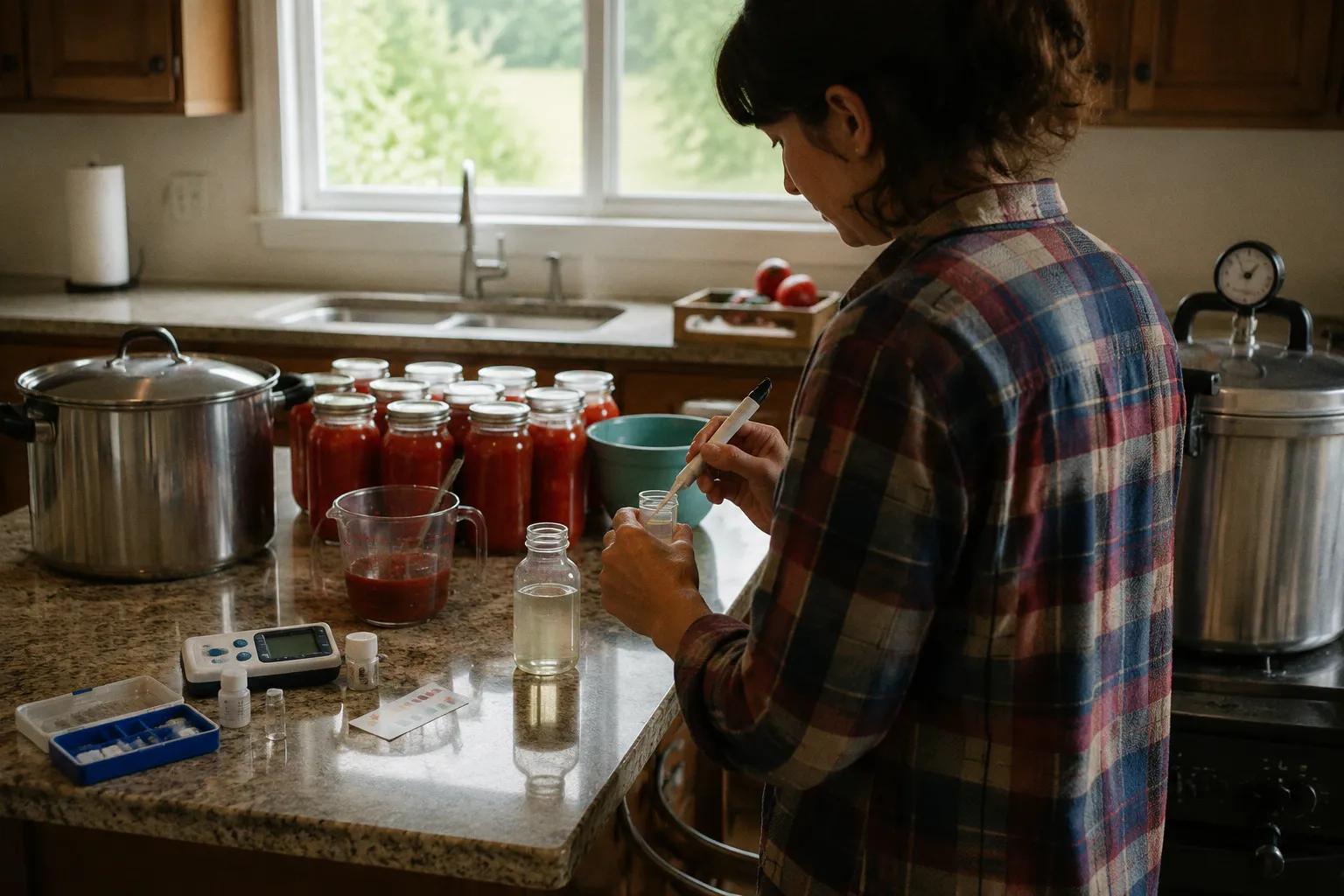
I have watched confident preservers wave off the question of acidity, trusting tradition or intuition alone, and I understand the impulse — so much of canning does live in the hands, in the senses, in knowledge passed through practice. But biochemistry does not yield to instinct. The margin between a safe jar and a dangerous one is not a matter of taste or aroma; it is a matter of hydrogen ion concentration, precise and measurable. If you are working with tomatoes, peppers, or any food that sits near that critical boundary, knowing your pH is not an optional refinement — it is the foundation on which every other preservation decision rests.
The 4.6 Threshold: Why pH is the Primary Defense Against *Clostridium botulinum*
Every jar you seal is a conversation with an organism that has outlived civilizations. The 4.6 line is the grammar of that conversation.
To stand in a kitchen in October is to participate in one of humanity's oldest negotiations — the truce between abundance and decay. Long before refrigeration, our ancestors discovered, often through tragedy, that certain environments kept food safe while others invited invisible ruin. Vinegar, citrus, fermentation, the smoke of autumn hearths — all of these were empirical solutions to what we now understand as pH: the measure of hydrogen ion activity in a solution, expressed on a logarithmic scale from 0 (extremely acidic) to 14 (extremely alkaline).
At the center of this understanding lies *Clostridium botulinum*, an anaerobic, spore-forming bacterium whose toxin is among the most potent known to science. Its spores are ubiquitous in soil, on produce, in dust. They survive boiling. They survive the water bath canner. They wait, dormant, for the right conditions: a moist, low-acid, oxygen-free environment at temperatures between roughly 40°F and 120°F. The pH of 4.6 is the boundary below which those spores cannot germinate, cannot reproduce, cannot produce toxin. Above that number — in a jar of plain green beans, a pot of corn, a chunk of unacidified tomato — the door swings open.
This is why pH is not a suggestion but a checkpoint. Foods that fall on the acidic side of 4.6 — most fruits, properly acidified tomatoes, pickles, jams, condiments — can typically be processed safely in a boiling water bath canner, where temperatures reach 212°F. Foods above 4.6 — vegetables, meats, seafood, soups, stocks, and most mixtures — require a pressure canner capable of reaching 240°F (116°C) or higher, the only home-processing method that destroys *C. botulinum* spores. The pH test is the way you confirm which side of the line your food lives on, and whether your processing method is matched to it.
Selecting and Calibrating Precision Tools for Acid Measurement
Anecdotes and inherited wisdom will only carry you so far. At some point, the canner must hand the work to instruments, and the instruments must be trusted. Two families of tools serve the home canner in measuring pH: digital pH meters (electrochemical sensors with a glass probe) and chemical test strips (paper or plastic strips impregnated with pH-sensitive dyes). Each has a place, each has limits, and neither is useful without preparation.
A digital pH meter, properly cared for, is the gold standard. It gives you a numerical reading to one or two decimal places, often within a tenth of a unit — precision that matters intensely when the safety boundary is 4.6 and a reading of 4.7 may be the difference between a safe shelf and a spoiled one. But a digital meter is only as honest as its last calibration. Before each use — and I mean each session, not each season — the meter should be calibrated with fresh buffer solutions, typically pH 4.0 and pH 7.0, which bracket the critical zone. The probe should be rinsed with distilled water between solutions, gently blotted (not rubbed) to avoid scratching the sensitive glass membrane, and stored according to the manufacturer's instructions, often in a storage solution rather than dry air.
Test strips, the simpler cousins, are portable, inexpensive, and surprisingly capable when chosen wisely. But the choice is where most home canners go astray. A universal strip with a 0–14 range is not a tool — it is a toy. The color gradations on such strips are too widely spaced to distinguish 4.4 from 4.7 with any confidence. For canning, you need strips whose active range sits squarely across the critical zone: a 3.0 to 5.0 spectrum is the standard recommendation, allowing you to read the 4.6 threshold with the granularity the decision demands. Strips have a finite shelf life once opened, and the dyes degrade with humidity, light, and time. Keep them sealed, dry, and dated.
| Tool | Best Use | Strengths | Limitations |
|---|---|---|---|
| Digital pH meter | Confirming borderline samples, recipe development, repeated batches | High precision (often ±0.1 pH), reusable, numerical readout | Requires calibration before each use, fragile probe, higher upfront cost |
| Narrow-range test strips (3.0–5.0) | Quick screening of clearly acidic foods, field checks, batch verification | Inexpensive, no calibration, portable | Color-matching subjectivity, lower precision near threshold, single-use, degrades over time |
| Universal strips (0–14) | Not recommended for canning safety | Wide utility for non-canning uses | Insufficient resolution near 4.6; cannot reliably distinguish safe from unsafe |
Navigating the Limitations of Test Strips vs. Digital pH Meters
The choice between a meter and strips is not a matter of superiority but of fit. I keep both in my kitchen, and I would encourage any serious home canner to do the same — not as a redundancy, but as a conversation between two ways of knowing.
Test strips shine in their speed and simplicity. When I am processing a batch of strawberry jam, where every berry is unmistakably acidic and the pH will land well below 4.0, a strip gives me a quick confirmation in under a minute. I dip, I wait, I compare. It is a humbler instrument, but in clear cases, humility is enough.
The meter, on the other hand, is what I reach for when the food is on the edge of ambiguity. A tomato harvest that includes a few underripe fruits. A salsa recipe that hovers near the line. A vegetable ferment that I want to confirm has reached its acid plateau. These are moments when a tenth of a pH unit matters, and only a properly calibrated meter can speak that language.
Common errors I have seen — and committed — deserve naming, because they are the kind of mistakes that survive into sealed jars:
- Skipping calibration. A digital meter that hasn't been calibrated with fresh buffers is not measuring pH; it is displaying a number derived from drift, age, and hope. Calibrate every session.
- Using expired or damp strips. If the color chart on your strip container has faded, or if the strips have been exposed to kitchen humidity, the readings will mislead you. When in doubt, replace the container.
- Testing cold samples. pH readings are temperature-sensitive. Allow the sample to come to room temperature, or use a meter with automatic temperature compensation.
- Testing only the surface. In a jar of canned food, the pH can stratify briefly after processing. Stir the sample thoroughly or take it from a well-mixed portion of the batch.
- Trusting a single reading. Take two or three readings from different jars in the batch. pH varies between individual tomatoes, between varieties, between soil conditions in the same field. Do not assume uniformity where biology insists on variation.
The Role of Acidification in Processing Low-Acid Vegetables and Tomatoes
Acid is not a flavor; it is a guarantee. When you add bottled lemon juice to a jar of tomatoes, you are not improving the taste — you are signing a contract with the safety of the people who will eat them.
Tomatoes sit in a peculiar corner of the canner's world. They are acidic enough, in the best years, to be processed in a water bath. They are variable enough, in the worst years, to be genuinely dangerous. A modern supermarket tomato bred for shipping firmness may test at pH 4.8 or higher, comfortably above the safety line. An heirloom San Marzano ripened on the vine in late August may test at 4.2. The species does not promise; the individual fruit decides.
This is why validated recipes for canning tomatoes — and for low-acid vegetables that are being acidified rather than pressure-canned — always call for added acid. Bottled lemon juice (with its standardized acidity of roughly 5%) or citric acid powder (more concentrated, more consistent) is added by the tablespoon or the teaspoon, calibrated to the volume of the jar. The point is not to make the food sour; it is to push the entire batch across the 4.6 line, definitively, regardless of where the produce itself began.
The same principle applies when you are canning low-acid vegetables like cucumbers (for pickles), cauliflower, or peppers intended for a future salad. The pickling brine carries the acidity, and the finished product must be tested to confirm it has landed in the safe zone. Recipes from university extension services and the National Center for Home Food Preservation are not suggestions; they are the accumulated laboratory work of generations of food scientists, and departing from them is the single most common path to an unsafe jar.
A quick reference for standard acidification rates, when working with tomatoes and similar borderline produce, drawn from validated extension guidelines:
- Pint jars of whole or crushed tomatoes: add 1 tablespoon bottled lemon juice or ¼ teaspoon citric acid per jar.
- Quart jars of whole or crushed tomatoes: add 2 tablespoons bottled lemon juice or ½ teaspoon citric acid per jar.
- Tomato sauce or juice (pints): add 1 tablespoon lemon juice; (quarts) 2 tablespoons.
- Salsa and mixed vegetable preserves: follow a tested recipe's acid additions exactly; do not improvise.
These figures are not arbitrary. They are calibrated to bring the typical pH range of the named produce below 4.6, assuming standard jar volumes and packing densities. If your produce is unusually low-acid to begin with, or if you are working with a variety known to test higher, the additional acid moves the whole batch further from the danger line. The goal is margin, not minimum.
Integrating pH Verification with Validated Pressure Canning Protocols
It is tempting, once you have a calibrated meter and a stack of narrow-range strips, to feel that pH is the answer to every canning question. It is not. pH is verification, not substitute. The two great pillars of safe home canning are acidity and heat, and they serve different foods through different mechanisms.
For high-acid foods — those that test at or below 4.6 — the boiling water bath canner is sufficient. The 212°F (100°C) temperature, sustained for the time specified in your validated recipe, destroys molds, yeasts, and the vegetative cells of spoilage organisms, while the low pH prevents *C. botulinum* from growing even if a few hardy spores survive. The water bath and the acid work together; neither is doing the full job alone.
For low-acid foods — vegetables, meats, seafood, soups, stocks, and any mixture that tests above 4.6 — only the pressure canner will do. At 240°F (116°C) or higher, achieved through 10 to 15 pounds of pressure (depending on altitude and canner model), the spores of *C. botulinum* are destroyed. This is the only home processing method that achieves this. A boiling water bath cannot reach these temperatures. A dishwasher cannot reach these temperatures. A low-acid food processed in anything other than a pressure canner is, in the language of food safety, an accident waiting for a year to pass.
A calibrated meter tells you the truth about your food. A validated recipe tells you what to do with that truth. Neither is useful without the other.
Where does pH verification fit in this picture? It is the honest check, the moment of accountability before the lid goes on. If your tomato sauce tests at 4.5, you can water-bath it with confidence. If it tests at 4.7, you must either add more acid and re-verify, or move the entire batch to the pressure canner. If your green beans test at 5.2, no amount of lemon juice will make them safe in a water bath — pressure canning is the only path. And if you are ever uncertain about a recipe, a variety, a new technique, the resources of your local cooperative extension service and validated canning guides are the only authorities worth consulting. For those navigating the wider landscape of foodborne illness, vaccination, or clinical concerns that touch on what we preserve and how we eat, broader wellness resources can offer additional context — because canning safety is part of a larger conversation about how we care for the bodies that receive what we seal.
Closing Reflection
I think often of my grandmother's pantry, and of the lineage of hands that have pressed lids onto jars since the first human decided that summer could be stored for winter. We inherit their knowledge imperfectly. Some of it lives in the body's memory, in the way a tomato sounds when you tap its skin, in the way a seal sucks down with a sound like a small kiss. Some of it must be relearned at the bench, with buffers and probes and the patient reading of color charts. The two kinds of knowledge are not rivals; they are the two hands of the same craft.
To verify pH is to take responsibility for what cannot be seen. The spores do not announce themselves. The toxin does not warn. The 4.6 line on the chart is the only border crossing that matters, and the instruments that let us read it — calibrated, fresh, matched to the work — are the modern canner's inheritance from a century of food science. Trust them. Trust the recipes that came from the laboratories and the kitchens of people who have done this work longer than any of us. And trust, finally, the quiet act of sealing a jar that you know, with your hands and your readings and your choices, is safe for the people who will open it.
The harvest is a promise. pH is how we keep it.