Maximum Residue Limits: How Pesticide Safety Is Measured
Every time I pick up a bell pepper at my local market, I am holding in my hand a quiet negotiation between two very different ideas of safety.
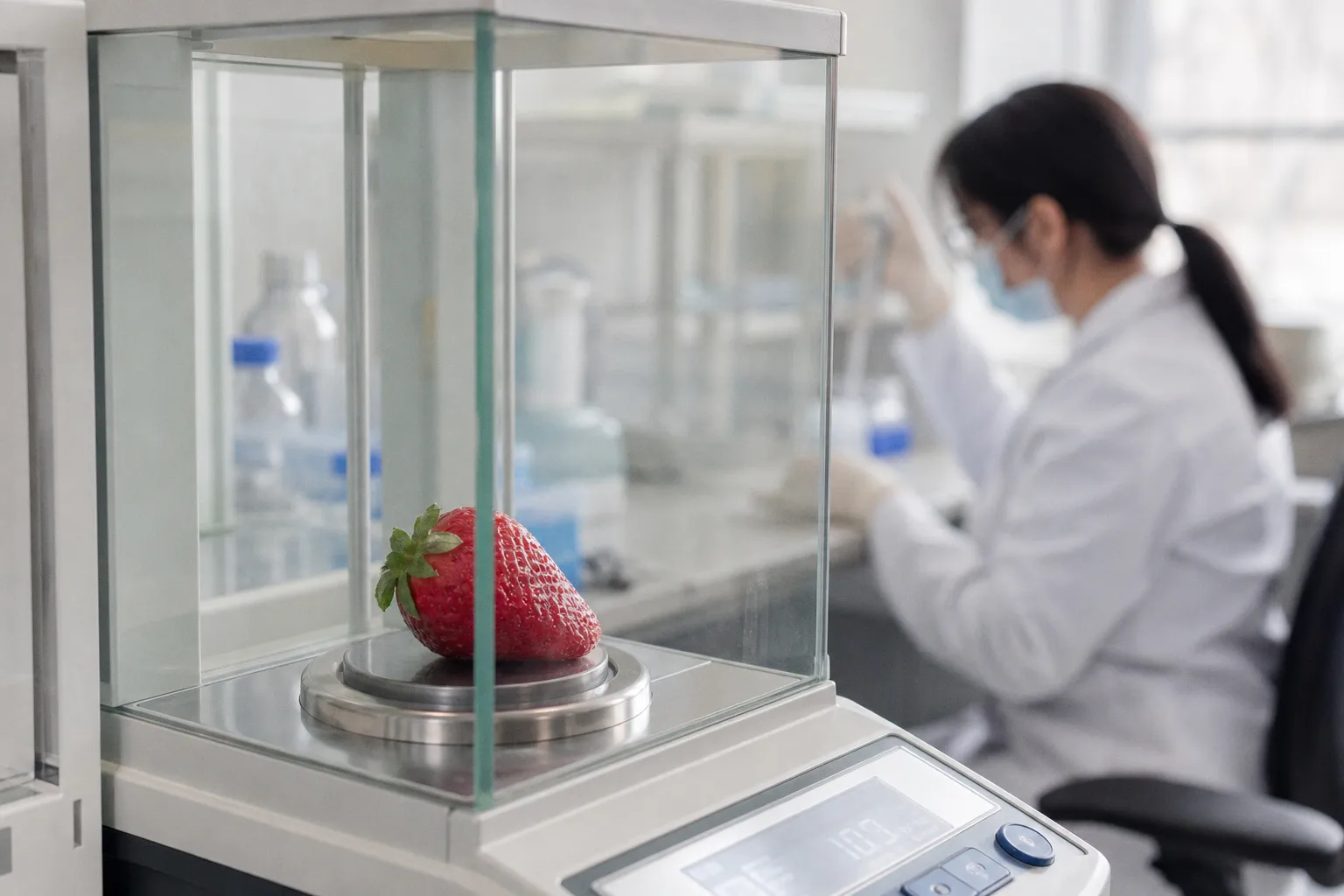
On one side sits the question my body asks — how much of any given pesticide can I actually consume before it matters to my health? On the other sits the question the regulatory system asks — what is the legal concentration of a specific pesticide permitted in or on this specific food? These are not the same question, and conflating them is, in my experience, the single most common pitfall in any public conversation about pesticide residues. Maximum residue limits, or MRLs, belong firmly to the second question. They are legal thresholds, not personal dose limits. Understanding that distinction is the difference between reading a residue report with clarity and misreading it as a verdict on your dinner.
An MRL is a legal concentration written into a specific pesticide–commodity pair. It is not a toxicological dose limit for the person eating the food.
What an MRL Actually Is
A maximum residue limit is a number attached to two things at once: a named pesticide and a named food. Apples and glyphosate. Spinach and chlorpyrifos. Strawberries and captan. The number itself is expressed as a concentration — milligrams of the pesticide per kilogram of the commodity, or its older U.S. cousin, parts per million — and it describes the highest residue that regulators are willing to allow in or on that specific food when it moves through legal commerce.
That framing matters. An MRL is set after a regulator reviews field trials run at the highest legal application rate, residue data from processed forms of the food, animal-product residue data where livestock feed is involved, monitoring data, food-consumption patterns, and the chemistry, toxicity, and exposure information about the active ingredient and its breakdown products. In the United States, before EPA sets such a tolerance, it must also have a practical analytical method in hand that can detect and measure the residue at the level being set as the limit. Without that method, the limit would be unenforceable on the ground, no matter how carefully it had been calculated on paper.
What an MRL is not, despite frequent confusion, is a measure of how much of the pesticide a person can safely eat. That measure has a different name and a different shape. The Codex Alimentarius Commission, the joint food-standards body of the Food and Agriculture Organization and the World Health Organization, expresses the long-term safety benchmark for a pesticide as an Acceptable Daily Intake, or ADI — milligrams of the chemical per kilogram of a person's body weight per day. The ADI is a toxicological judgment about intake. The MRL is a legal concentration in food. They are related, because MRLs are typically set well below concentrations that would push a realistic diet past the ADI, but they are not the same instrument, and treating them as interchangeable distorts both.
How the United States Builds a Tolerance
In the United States the term most often encountered is not "MRL" but "tolerance," and the body that sets them is the Environmental Protection Agency. A tolerance is the maximum residue of a specific pesticide legally permitted in or on a specific human or animal food, and residues above it can trigger enforcement action, including seizure of the commodity.
The legal backbone of this system is the Federal Food, Drug, and Cosmetic Act, reshaped in meaningful ways by the Food Quality Protection Act of August 1996. That statute tightened the standard EPA must apply: tolerances must be safe under a "reasonable certainty of no harm" from aggregate exposure. The word aggregate is doing real work in that sentence — it forces EPA to add up exposure through food residues, drinking water, and residential settings, and to consider whether infants and children may be more susceptible than the general population.
To arrive at a tolerance, EPA draws on a stack of evidence streams rather than a single number:
- Field trials conducted at the highest pesticide application rate allowed by the label.
- Processed-food residue studies, because cooking, juicing, or milling can concentrate or break down residues.
- Animal-product residue data where livestock may consume treated feed.
- Monitoring data from prior years.
- Food-consumption data, to estimate realistic dietary intake.
- Chemistry, toxicity, and exposure information about the pesticide and its breakdown products.
The agency then publishes the tolerance in the Code of Federal Regulations, and enforcement flows outward from there. FDA carries the residue-monitoring load for most domestic foods moving in interstate commerce and for foods offered for import. USDA's Food Safety and Inspection Service regulates the categories excluded from FDA's role — meat, poultry, catfish, and certain egg products.
The Codex Frame for International Trade
When food crosses borders, the conversation usually shifts to the Codex Alimentarius. Codex MRLs are expressed in milligrams per kilogram of the commodity and are derived after the Joint Meeting on Pesticide Residues, the expert body that pairs FAO and WHO scientists, completes a toxicological assessment and reviews supervised residue trials that reflect Good Agricultural Practice in the field.
By the close of the 48th session of the Codex Alimentarius Commission in November 2025, the pesticide-residue database included 6,522 adopted MRLs and 63 extraneous MRLs — limits set for chemicals whose use is no longer authorized but whose residues persist in the environment. The Codex definition of "pesticide residue" itself is broader than many readers expect: it can include the parent compound plus its conversion products, metabolites, reaction products, and toxicologically significant impurities, and it can capture residues from unknown or unavoidable environmental sources as well.
It is worth pausing here, because the Codex framing is sometimes mistaken for a global ceiling that overrides national law. It is not. Codex MRLs are primarily intended to facilitate international trade, and countries are free to set or apply their own domestic limits. Treat them as a reference grid that helps trade flow, not as a single authority that resolves every residue question.
The EU's Distinct Approach
The European Union handles the gaps in its MRL grid differently from the United States. Where no specific EU MRL has been set for a given pesticide–food combination, a general default MRL of 0.01 mg/kg applies. The European Commission is explicit that the United States does not operate an equivalent default — a structural difference that matters when commodity flows move across the Atlantic and residues detected at very low levels can be legal in one jurisdiction and over-limit in another.
Different jurisdictions answer the same residue question with different tools — and those tools do not always line up cleanly across borders.
The table below sketches how the three systems diverge when faced with the same residue problem.
| Parameter | U.S. tolerance (EPA) | Codex MRL | EU MRL |
|---|---|---|---|
| Term used | Tolerance | MRL | MRL |
| Set by | EPA | Codex Alimentarius Commission | European Commission / Member States |
| Concentration unit | ppm (parts per million) | mg/kg of commodity | mg/kg of commodity |
| Default when no specific limit exists | No general default | No general default | 0.01 mg/kg |
| Safety standard | "Reasonable certainty of no harm" from aggregate exposure (FQPA, 1996) | Derived after JMPR toxicological assessment and GAP-based residue trials | Based on EU risk assessment, with consumer exposure considerations |
| Primary legal use | Domestic enforcement and import control | International trade reference | Domestic enforcement and import control |
That difference in defaults is not a curiosity. It is the reason a shipment of, say, dried herbs can clear U.S. import inspection with a trace residue and run into a compliance question in an EU port for exactly the same analytical result.
How Regulators Actually Detect What Is There
A residue limit without a measurement method is a wish, which is why analytical verification sits at the heart of any compliance system. In the United States, FDA's regulatory pesticide-residue monitoring program tests both domestic and imported foods, and its multi-residue method can analyze approximately 800 pesticide residues in a single analytical run. Selective methods then cover residues that fall outside the scope of that broad screen.
A subtle distinction in the U.S. framework often surprises readers: an FDA pesticide action level is not the same thing as an EPA tolerance. Action levels are recommended rather than legally binding, and FDA may set one for an unavoidable residue when no tolerance or tolerance exemption exists. If you are reading an FDA document and the phrase "action level" appears, you are looking at a guidance value, not the same instrument as a tolerance.
This is also where a useful piece of caution enters the picture. A detected residue is not automatically a legal violation. Compliance depends on the specific pesticide and commodity in question, the residue definition the regulator is using, the applicable tolerance or MRL in the relevant jurisdiction, and, in some systems, the measurement uncertainty around the result. Reading a residue table without those qualifiers is a reliable way to misread it — and the same goes for headline summaries that strip the qualifications away.
What the Monitoring Numbers Actually Show
Two large monitoring programs give a useful snapshot of how often residues show up in the food supply, though they cannot be stacked against each other as if they measured the same thing.
The USDA Pesticide Data Program, focused on the U.S. domestic market, released its calendar-year 2024 annual summary in December 2025. Across the commodities sampled, more than 99 percent had residues below the EPA tolerances established for those pesticide–commodity pairs, and roughly 42.3 percent had no detectable residue at all. USDA is careful to note that the program is not designed to enforce EPA tolerances — it is a presence-and-trend tool, not an enforcement instrument, and treating its detection rates as violation rates is a category error.
The European Coordinated Multiannual Control Programme, by contrast, is built with enforcement in mind across the EU's member states. Its 2024 cycle drew 9,842 samples, with 43.1 percent of results below the limit of quantification — meaning no residue was detected at a level the labs could reliably measure — and 54.5 percent at or above that quantification limit. Whether any of those measured results constitute a non-compliance finding depends on the specific EU MRL for that pesticide–commodity pair, not on the simple fact of detection.
A few practical reading habits follow from these numbers:
1. Treat "no detectable residue" as a meaningful data point, but remember that detection limits vary by analyte and by lab method — a non-detection in one program is not automatically a non-detection everywhere.
2. Treat "below the tolerance" as a compliance statement for that commodity–pesticide pair, not as a guarantee of zero exposure or zero risk.
3. Treat "above the limit of quantification" as a measurement, not a violation — the question of legality lives one layer up, at the MRL.
4. Resist the temptation to translate detection rates directly across programs. Different sampling designs, commodity baskets, and legal frameworks make cross-program comparisons misleading even when the percentages look superficially similar.
The Practical Takeaway
If I leave you with one habit, it is this: when you read a number about pesticide residues, ask first what kind of number you are looking at. A concentration in food is not a dose to a person. A legal limit is not a safety claim. A detection is not a violation. A monitoring program is not an enforcement action.
The architecture that wraps around your produce is denser than it looks — tolerances set by EPA under a post-1996 safety standard, Codex MRLs facilitating trade across borders, an EU default of 0.01 mg/kg filling in where specific limits have not been set, and analytical methods that can screen hundreds of residues in a single run. Each piece does a different job, and the system only works if the reader keeps those jobs distinct. Once you do, a residue report stops looking like a verdict on your dinner and starts looking like what it has always been: a layered conversation between chemistry, agriculture, and law, written into every bite of food that crosses a border.