Regenerative agriculture: a five-step guide to soil health
Regenerative agriculture is often marketed as though it were a fixed production standard with predictable outcomes: healthier soil, more carbon stored, fewer inputs, greater resilience. The evidence does not support that level of certainty.
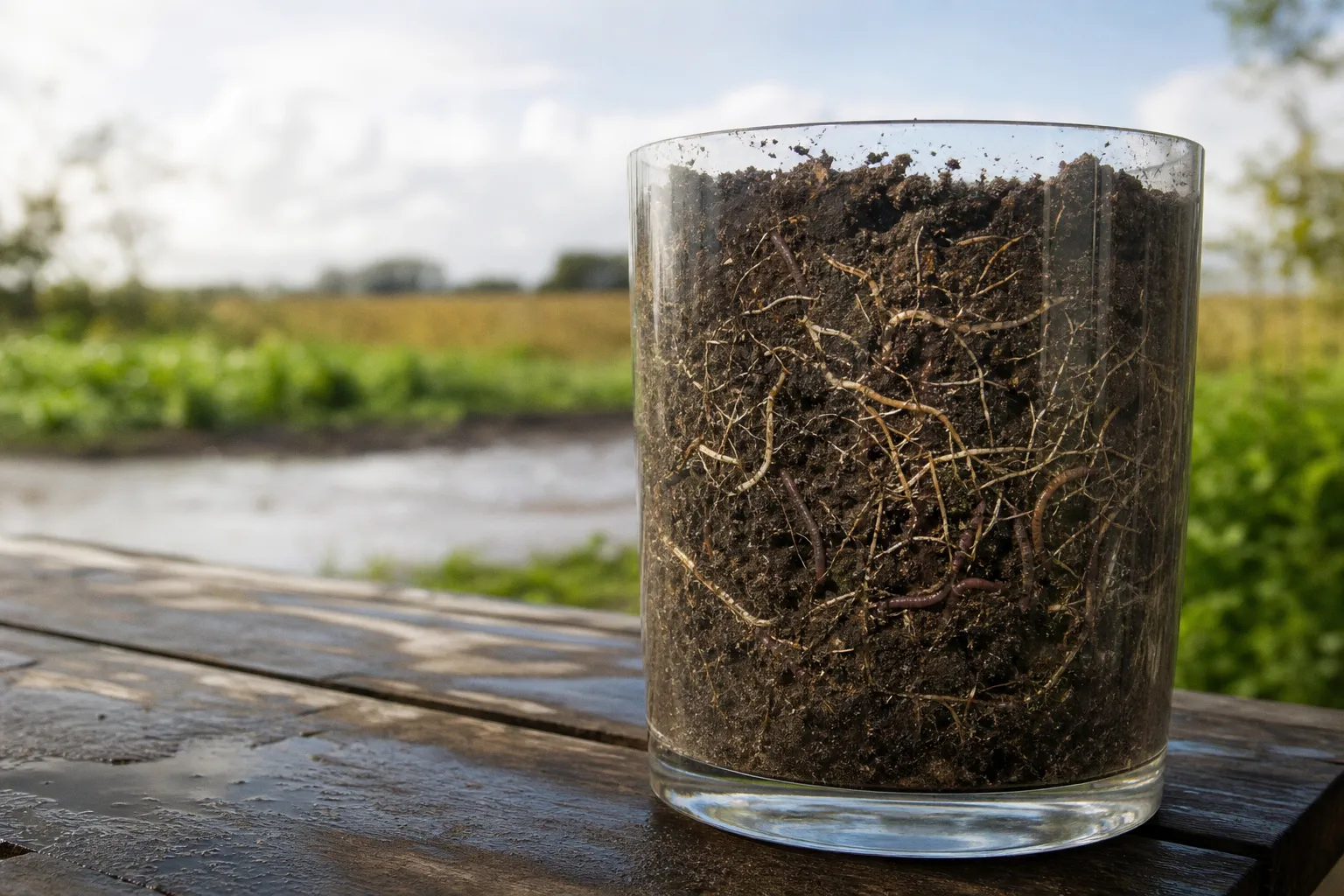
There is no single legal or universally accepted definition of regenerative agriculture, and no numerical threshold that can certify a field as “regenerative” in any scientifically complete sense.
A more defensible hypothesis is narrower: management that reduces physical disruption, maintains soil cover, keeps plants actively rooting for more of the year, and increases biological diversity should improve the conditions under which soil functions as a living ecosystem. That is the framework used by the USDA Natural Resources Conservation Service (NRCS). It is not a promise of yield or profit. It is a set of soil-health mechanisms that can be measured over time.
The five steps below separate the necessary measurement stage from the four NRCS soil-health management principles. This distinction matters. Four principles are official guidance; the baseline is the analytical control without which claims of soil health restoration are largely anecdotal.
1. Establish a soil-health baseline before changing the system
The first step in regenerative farming is not planting a cover crop or buying a no-till drill. It is determining what exists before the intervention.
Soil is chemically and biologically heterogeneous. A low-lying section of a field may differ substantially from a slope 200 metres away in texture, drainage, organic carbon, compaction history, and nutrient availability. Combining them into one sample can produce a tidy laboratory report with very limited diagnostic value.
A useful baseline should include multiple indicators rather than a single “soil health score.” The Soil Health Institute sampling framework includes:
- Soil organic carbon, a central component of soil organic matter and a relevant measure for carbon sequestration in soil;
- Total nitrogen, which indicates the overall nitrogen reservoir but does not, by itself, predict near-term crop availability;
- Potential carbon mineralization, a proxy for microbial activity under controlled laboratory conditions;
- Texture, the relative proportion of sand, silt, and clay, which determines much of the soil’s inherent water-holding and nutrient-retention capacity;
- Aggregate stability, indicating how well soil particles remain bound when exposed to water;
- Bulk density, which can indicate compaction and restrictions to root penetration.
The sampling design is as consequential as the laboratory assay. Separate samples where soil type, topography, cropping history, or management differs. Repeat sampling at comparable moisture and temperature conditions when tracking trends. A wet spring sample cannot be meaningfully compared with a drought-period sample merely because both were taken in the same calendar month.
What a baseline can and cannot show
| Measurement | What it can help identify | What it cannot prove alone |
|---|---|---|
| Soil organic carbon | Long-term changes in carbon-containing organic matter | That a specific practice caused the change |
| Aggregate stability | Susceptibility to crusting, erosion, and structural breakdown | Total biological functioning |
| Bulk density | Potential compaction and limited pore space | Whether roots are restricted at every depth |
| Potential carbon mineralization | Relative microbial activity under test conditions | Field-level nutrient release during a season |
| Total nitrogen | Size of the nitrogen pool | Crop-available nitrogen at a specific growth stage |
Photographs of darker soil, visible earthworms, or a single infiltration demonstration may be useful observations. They are not a baseline. Nor are they evidence that a particular change has generated an agronomically or climatically meaningful outcome.
Soil health is not an aesthetic category. It is a set of physical, chemical, and biological functions measured against an appropriate reference point.
2. Minimize disturbance, but do not convert “no-till” into dogma
The second step is to reduce unnecessary disturbance of soil structure and microbial habitat. Tillage disrupts aggregates, exposes organic matter to oxygen, cuts fungal hyphae, and can damage pore networks formed by roots and soil organisms. NRCS also identifies tillage as a contributor to reduced water infiltration, greater runoff, and increased erosion susceptibility.
The operational implication is straightforward: till only where there is a defined agronomic reason, and distinguish between reducing disturbance and eliminating every form of disturbance.
No-till farming benefits can include lower fuel use, fewer machinery passes, less labour at planting, and better retention of surface residues. These are plausible advantages, not guaranteed outputs. In poorly drained soils, cool wet springs can delay planting under heavy residues. In systems without appropriate cover-crop termination, weeds or volunteer plants can compete for water. In some production environments, strategic tillage may be used to correct severe compaction or incorporate amendments.
The relevant question is not whether tillage is morally acceptable. It is whether the anticipated benefit exceeds the structural and biological cost in that field, during that season.
A disciplined transition generally proceeds as follows:
1. Map compaction and traffic patterns. Random machinery movement converts a manageable problem into field-wide compaction. Permanent traffic lanes, where practical, confine pressure to a smaller area.
2. Reduce the frequency and intensity of passes. A shallow pass, strip-till operation, or fewer operations may be a meaningful reduction in disturbance even when full no-till is not currently feasible.
3. Retain crop residues where agronomically compatible. Residue buffers raindrop impact, moderates surface temperature, and provides carbon substrate for soil organisms.
4. Monitor weed pressure and nutrient placement. Reduced tillage changes weed ecology and fertilizer dynamics. A plan based solely on avoiding soil movement frequently transfers the problem to higher herbicide dependence or poor nutrient placement.
5. Compare outcomes against the baseline. Monitor bulk density, aggregate stability, infiltration observations, fuel use, field operations, and yield stability over several seasons.
The biochemistry is not mysterious. Soil organic matter becomes vulnerable when protected aggregates are broken apart and carbon compounds are exposed to microbial oxidation. But the rate and magnitude of that effect depend on clay content, temperature, moisture, existing carbon levels, residue inputs, and management history. Broad claims that no-till automatically produces large carbon gains are therefore analytically weak.
3. Keep the soil covered between cash crops
Bare soil is an exposed surface subject to raindrop impact, wind erosion, temperature fluctuation, crust formation, and direct water loss. The third regenerative agriculture principle is to maximize soil cover.
Cover can come from crop residues, annual crops, perennial vegetation, living mulches, and cover crops. The objective is functional rather than decorative: maintain a physical barrier between the atmosphere and the soil surface for as much of the year as the local system permits.
Cover cropping techniques should be selected according to the gap between cash crops, expected moisture availability, termination options, pest pressures, and the next crop’s nutrient requirements. Rye, wheat, oats, clovers, other legumes, radishes, turnips, and triticale are all used as cover crops. None is universally correct.
For example, a cereal cover can produce substantial residue and suppress some weeds, but may also immobilize available nitrogen during decomposition if the residue has a high carbon-to-nitrogen ratio. A legume may contribute biologically fixed nitrogen, but its establishment and winter survival depend on climate and timing. Brassicas can produce strong rooting effects, yet are not interchangeable with cereals or legumes in rotation systems with disease concerns.
Cover crops have expanded in U.S. production, but adoption remains far from universal. Cropland planted to cover crops increased from 15,390,674 acres in 2017 to 17,985,831 acres in 2022, a 17% rise. Even so, cover crops represented only 4.7% of total U.S. cropland in 2022. This is not evidence of farmer ignorance. It reflects real constraints: seed cost, equipment, labour, termination timing, moisture limitations, short growing seasons, and uncertain economic return.
In colder or drier regions with short seasons, establishment after harvest can be particularly difficult. A recommendation to “always plant a cover crop” is therefore not practical guidance. A better recommendation is to identify the period of bare soil, quantify the available growing window, and test species or mixtures on a manageable acreage before scaling.
Soil cover is not a symbolic green layer. Its value depends on establishment, biomass, timing, termination, and what it displaces in the production calendar.
4. Maintain living roots to feed the rhizosphere
Soil cover and living roots are related but biologically distinct. Dead residue protects the surface and supplies organic material. Living roots do something more specific: they maintain the rhizosphere, the narrow zone surrounding roots where microbial activity is concentrated.
Plants release root exudates containing carbon compounds that support bacteria, fungi, and other organisms. In exchange, this microbial network participates in nutrient cycling, aggregate formation, and interactions that can influence root function. The process is not a commercial “soil microbiome activation” narrative; it is ordinary plant–microbe ecology.
The practical aim is to reduce periods during which the soil has neither a cash crop nor a cover crop growing. Cover crops following short-season cash crops can keep the soil food web supplied during periods that would otherwise be biologically quiet.
This does not mean that every field should contain living roots every day of the year. Frost, drought, harvest timing, and regional climate determine what is feasible. It does mean that a rotation should be examined for long fallow intervals that offer neither erosion protection nor substantial biological activity.
A technically sound assessment asks:
- How many weeks annually does the field have active roots?
- Which interval has the highest erosion or runoff risk?
- Is there sufficient moisture for establishment without compromising the next cash crop?
- Does the selected cover crop complement or compete with the following crop?
- Can the crop be terminated reliably using the available equipment and local weather conditions?
The answer may be an overwintering cereal, a frost-seeded legume, a short-season mixture, an interseeded cover, or no cover crop in a specific year. Regenerative farming principles describe the direction of travel. They do not eliminate agronomic trade-offs.
5. Increase biodiversity across the rotation and landscape
The fourth NRCS principle is to maximize biodiversity. In practice, this may include diversified crop rotations, multi-species cover crop mixtures, integration of perennials, habitat considerations, and—under appropriate conditions—properly managed grazing animals.
Diversity matters because monoculture simplifies the biological and economic system. A short rotation repeatedly selects for the same weeds, pest cycles, nutrient demands, rooting patterns, and seasonal labour peaks. A more diverse rotation can distribute those pressures, though it also requires more management competence and may require access to different markets.
The most useful scale for evaluating biodiversity is not a catalogue of species but a functional comparison:
| System feature | Narrow system | More diversified system |
|---|---|---|
| Root architecture | Repeatedly similar rooting depth and pattern | Multiple rooting depths and root types over time |
| Carbon inputs | Concentrated in a single residue type | More varied residues and root exudates |
| Pest and weed pressure | Recurrent selection for the same organisms | Greater disruption of some pest and weed cycles |
| Nutrient demand | Similar timing year after year | More varied nutrient uptake and residue decomposition patterns |
| Economic exposure | Reliance on fewer crop markets | Potentially broader revenue sources, with added complexity |
Livestock integration is often presented as the defining feature of regenerative agriculture. It is not an NRCS fifth principle, and it is not mandatory. Properly integrated grazing can increase biological diversity and return nutrients to the land. Improperly managed grazing can compact soil, damage cover, increase erosion, and undermine the soil-health system it was supposed to support.
The same conditional reasoning applies to cover-crop mixtures. More species do not automatically produce better results. A five-species mixture is not necessarily superior to a well-chosen cereal–legume pairing if establishment is poor, moisture is limited, or termination is unreliable. Biological diversity must be functional, not merely numerically impressive.
Treat carbon claims as measurements, not assumptions
Carbon sequestration in soil is a legitimate scientific objective, but it is routinely described with excessive confidence. Soil carbon stocks vary with depth, bulk density, sampling method, spatial variability, and laboratory analysis. A surface sample alone may indicate a change in the top few centimetres while missing offsetting changes deeper in the profile.
Moreover, increased carbon inputs do not guarantee persistent carbon storage. Carbon entering the soil through roots and residues can be respired by microbes, incorporated into mineral-associated organic matter, retained in aggregates, exported through erosion, or redistributed within the profile. The outcome is governed by soil mineralogy, climate, management, and time.
This does not invalidate regenerative agriculture. It establishes the standard of evidence required to evaluate it. Claims should be phrased as observed changes in defined measurements over a stated period, not as universal climate outcomes inferred from a management label.
A farm can reasonably report that a reduced-disturbance, covered, diversified system improved aggregate stability or reduced visible runoff relative to its own baseline. It should not claim a specified quantity of durable carbon sequestration without repeated, methodologically consistent measurements.
The verdict: regenerative agriculture is a framework, not a certification
Regenerative agriculture becomes useful when stripped of its imprecision. It is not synonymous with organic certification, no-till farming, livestock grazing, or cover crops. It is also not a five-item branding exercise.
The evidence-supported framework is simple:
1. Establish a multi-metric baseline.
2. Minimize soil disturbance.
3. Maintain soil cover.
4. Keep living roots present where feasible.
5. Increase functional biodiversity.
The mechanisms are credible. Tillage can disrupt soil structure; cover reduces exposure; roots sustain rhizosphere activity; diversity can reduce biological simplification. But field-level outcomes remain conditional on climate, soil texture, crop sequence, water availability, equipment, and management quality.
The strict conclusion is therefore statistical rather than promotional: regenerative practices should be adopted as testable interventions, measured against a baseline over multiple seasons. Without that comparison, the word “regenerative” describes an intention. With it, the term can begin to describe an observable soil-management outcome.