Sanitize Food Processing Equipment in 5 Steps
The working hypothesis is simple: sanitizing food processing equipment fails most often not because the sanitizer is weak, but because the surface presented to it is biochemically unsuitable.
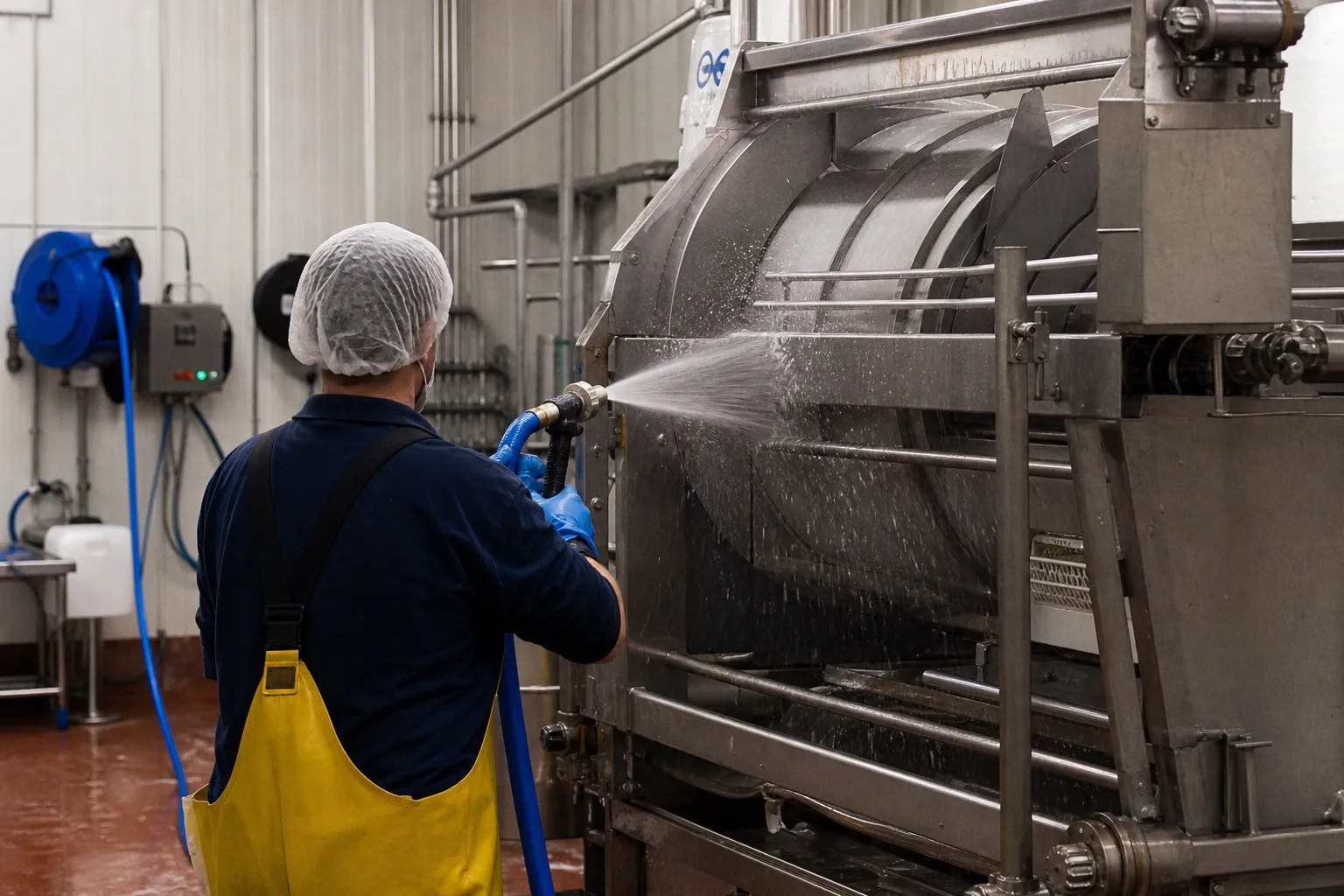
For food processing equipment, the correct sequence is not a decorative ritual. It is a controlled reduction of soil load and microbial burden: pre-clean, clean, rinse, sanitize, dry. Omit one stage, or collapse cleaning and sanitizing into the same act, and the process loses its logic. The equipment may look acceptable. The surface microbiology may not agree.
The Critical Distinction Between Cleaning and Sanitizing
Cleaning and sanitizing are often paired in operating documents, but they are not interchangeable. Cleaning removes soil. Sanitizing reduces microorganisms on an already clean surface to an acceptable level. The distinction is not semantic; it is chemical and operational.
Food residues interfere with sanitizers in several ways:
- Organic matter consumes active chemistry. Chlorine-based sanitizers, for example, are rapidly depleted by proteins and other organic loads. A label concentration in the bucket is not the same as an effective concentration at the microbial surface.
- Fat films reduce wetting. Lipid residues are hydrophobic and can prevent uniform sanitizer spread across stainless steel, gaskets, blades, filler heads, and conveyor contact surfaces.
- Mineral scale shelters organisms. Hard-water deposits create microtopography where cells can persist beyond routine exposure.
- Biofilm matrix limits diffusion. Extracellular polymeric substances act as a physical and chemical barrier, reducing the apparent bioavailability of the antimicrobial agent.
A visibly clean surface is therefore a minimum precondition, not proof of sanitation. In a dairy line, sauce kettle, slicer, depositor, or fermentation vessel, visual inspection detects gross failure. It does not validate microbial reduction.
Sanitizer is not a solvent for poor cleaning. It is the final antimicrobial intervention after soil has already been removed.
This distinction is especially relevant for food processing equipment with seams, dead legs, hollow rollers, badly fitted guards, or worn elastomers. Stainless steel may be the preferred food-contact material, particularly 304 or 316 grade, because it is non-absorbent, corrosion-resistant, and cleanable. Yet grade alone does not guarantee sanitation. Surface finish, weld quality, drainage angle, and mechanical access determine whether the chemistry can reach the relevant areas.
Applying the TACT Principle to Equipment Maintenance
Cleaning performance is commonly described by the Sinner's Circle, also known as the TACT principle: Time, Action, Concentration, and Temperature. The model is useful because it prevents a common error in sanitation programs: treating chemical concentration as the only variable that matters.
In practice, the four variables trade against one another within safe and validated limits.
| TACT factor | What it controls | Practical implication for food processing equipment |
|---|---|---|
| Time | Duration of detergent or sanitizer contact | Too short an exposure produces incomplete soil removal or microbial reduction, even when the chemistry is correct |
| Action | Mechanical energy: brushing, turbulence, spray impact, scrubbing | Biofilm and dried residues usually require mechanical disruption, not passive soaking alone |
| Concentration | Detergent or sanitizer strength | Must match soil type, water quality, and regulatory or label requirements |
| Temperature | Reaction kinetics, fat melting, detergent activity | Hot water sanitation commonly operates in a broad range such as 100–180°F, depending on method and equipment tolerance |
Temperature deserves careful handling. Warmer conditions often improve removal of fats and increase cleaning kinetics, but excessive heat can denature proteins onto surfaces, accelerate corrosion in susceptible components, or damage seals and plastics. A heated wash that bakes milk protein into a plate heat exchanger is not a stronger wash; it is a more expensive failure.
Mechanical action is similarly underappreciated. Clean-in-place systems rely on flow velocity, turbulence, and spray coverage. Open equipment relies on directed scrubbing, foam contact, and dismantling where required. In either case, action must reach the actual food-contact zone. A high-pressure spray directed at the easy surfaces leaves the underside of scraper blades, shaft collars, and gasket grooves analytically unresolved.
The concentration variable is where marketing frequently becomes unhelpful. "Stronger" is not a scientific category. Detergents and sanitizers operate within specified ranges. Above those ranges, one may increase residue risk, material degradation, worker exposure, corrosion, or regulatory non-compliance without improving microbial control. Below them, efficacy declines. Local water hardness and soil chemistry also alter performance, which is why one facility's acceptable program cannot be copied blindly into another.
The 5-Step Protocol: From Debris Removal to Air Drying
A defensible sanitation protocol for food processing equipment follows five ordered steps. The sequence matters because each step prepares the surface for the next one.
1. Pre-clean: remove gross debris before chemistry is applied
Pre-cleaning removes visible food residues: dough scraps, meat particles, vegetable matter, curd, sugar deposits, powders, sauces, and packaging fragments. This is the stage where operators dismantle removable parts, scrape surfaces, empty collection points, and flush loose material from accessible zones.
The aim is not sterilization. The aim is load reduction. Detergents and sanitizers should not be asked to penetrate a centimeter of product residue on a belt return roller or beneath a mixer paddle. That is not sanitation; it is chemical optimism.
Effective pre-cleaning generally includes:
1. Dry removal where appropriate. Powders, flour, spices, and dry mixes may be better removed by vacuuming or controlled dry methods before introducing water. Premature wetting can create paste-like residues.
2. Disassembly of removable food-contact parts. Blades, nozzles, screens, funnels, filler tubes, and gaskets must be exposed if the process soils them internally.
3. Control of splash and aerosol. Aggressive hosing during pre-cleaning can spread organisms from floors and drains onto equipment surfaces.
4. Removal of trapped product. Hinges, hollow framework, cracked belt surfaces, and damaged seals commonly retain soil after superficial rinsing.
Pre-cleaning is also the first inspection point for equipment design defects. If a component cannot be accessed, drained, or dried, it should not be treated as a minor inconvenience. It is a recurring sanitation hazard.
2. Clean: use detergent to remove adhered soil
Cleaning uses detergent chemistry, water, temperature, and mechanical action to remove soil films. The detergent must correspond to the soil matrix. Protein, fat, carbohydrate, mineral scale, and mixed residues do not respond identically.
A simplified pairing is useful:
| Soil type | Common equipment context | Cleaning emphasis |
|---|---|---|
| Protein | Dairy systems, meat slicers, egg processing, fermentation residues | Alkaline detergency, controlled temperature, adequate contact time |
| Fat and oil | Frying systems, sauces, nut pastes, meat processing | Emulsification, hot water where compatible, mechanical action |
| Starch and sugar | Bakery, confectionery, beverage syrups | Dissolution, prevention of dried films, targeted scrubbing |
| Mineral scale | Heat exchangers, kettles, evaporators, hard-water areas | Acid cleaning at validated intervals |
| Mixed bio-organic residue | Drains, belts, gaskets, fillers, conveyors | Sequential cleaning plus mechanical disruption |
This is where "how to check sanitize food processing equipment in 5 steps" becomes more than a phrase. The check is not postponed until the end. It begins here: if soil remains after cleaning, the sanitizing step is already compromised.
Inspection after cleaning should be systematic. Operators should examine underside surfaces, product shadows, weld seams, fasteners, hollow areas, scraper edges, and seals. ATP testing may be used in some facilities as a rapid hygiene indicator, although it is not a direct pathogen test. Microbiological swabbing may be required for verification programs. The central point remains conservative: no visible residue should proceed to sanitizer.
3. Rinse: remove detergent residues without recontaminating the surface
Rinsing removes suspended soil and detergent residues. Detergent left on food-contact surfaces can neutralize or interfere with sanitizers, cause off-flavors, or create chemical residue concerns. Rinse water quality therefore matters. Water that introduces sediment, microorganisms, or excessive mineral load can reverse progress.
Rinsing should be thorough but controlled. Excessive pressure may aerosolize contaminants from non-food-contact areas. In open-plant environments, the direction of rinse flow should move soil away from cleaned areas, not across them. On complex food processing equipment, operators should verify that rinse water exits from low points and does not pool inside housings, pipes, or guards.
The rinse stage also exposes drainage problems. Persistent pooling indicates either poor equipment orientation, blocked drains, damaged components, or inadequate disassembly. Standing water dilutes sanitizer and supports microbial survival after sanitation.
4. Sanitize: apply the approved antimicrobial intervention
Sanitizing reduces microorganisms on a cleaned surface. Common sanitizer classes include chlorine compounds, quaternary ammonium compounds, and peracetic acid. Each has distinct compatibility, activity spectrum, residue profile, and sensitivity to environmental variables.
Sanitizers must be used at concentrations approved by the relevant regulatory bodies and according to the product label or validated facility procedure. In the United States, this commonly involves FDA or EPA-regulated requirements depending on product type and application. Exact concentrations and dwell times vary by sanitizer formulation, application method, water chemistry, surface type, temperature, and target organism. A responsible protocol does not invent universal numbers.
The correct operational approach is more rigorous:
- Prepare sanitizer using measured dilution, not visual approximation.
- Verify concentration with an appropriate test strip, titration kit, or calibrated method specified for the chemical.
- Confirm that the surface has already been cleaned and rinsed.
- Apply sanitizer to all food-contact areas, including dismantled parts and difficult geometries.
- Maintain wet contact for the required dwell time.
- Prevent post-sanitizing contamination from gloves, tools, hoses, splash, compressed air, or unclean carts.
Chemical selection should also account for material compatibility. Stainless steel 304 and 316 tolerate many sanitation chemistries under correct conditions, but misuse can still cause corrosion, pitting, or surface roughening. Elastomers, plastics, and soft metals may be more vulnerable. A pitted surface increases microbial retention and becomes progressively harder to clean, which is a biochemical and engineering problem, not an aesthetic one.
5. Air dry: prevent dilution, pooling, and recontamination
Air drying is not a decorative final step. It reduces residual water that can dilute sanitizer, support surviving organisms, and facilitate transfer from non-sterile surfaces. Equipment should be positioned to drain freely. Parts should be stored so that food-contact surfaces do not touch contaminated racks, floors, splash zones, or each other in a way that traps moisture.
Towel drying is generally a weak practice for food-contact surfaces unless the wiping material is controlled, sanitary, and part of a validated procedure. Cloth can transfer organisms and lint. Compressed air is also not automatically acceptable; if it is not filtered and hygienically controlled, it may deliver oil, water, or microorganisms to the very surface just sanitized.
At the end of drying, the equipment should be protected from environmental recontamination. Open fillers beneath condensation points, exposed belts near drains, or sanitized utensils stored beside raw-product traffic lanes represent process design failures. Sanitation ends only when the clean state is preserved until production.
Combating Biofilms on Stainless Steel Surfaces
Biofilms are structured microbial communities attached to a surface and embedded in extracellular polymeric material. On food processing equipment, they may develop in niches where moisture, nutrients, and inadequate mechanical removal coexist. Stainless steel reduces the risk compared with porous or corroding materials, but it does not prevent attachment.
Biofilm control is difficult because the organisms are not behaving like freely suspended cells in a laboratory tube. Their matrix changes exposure. Cells within deeper layers may experience reduced sanitizer concentration, altered pH microenvironments, and slower metabolic states. Data from food microbiology consistently suggests that mature biofilms are more resistant to standard sanitation than planktonic organisms.
Typical biofilm-prone locations include:
- gasket grooves and poorly seated seals;
- conveyor belt cracks, hinges, and modular belt joints;
- filler nozzles and valve interiors;
- floor-adjacent equipment legs and splash zones;
- hollow rollers or framework with moisture ingress;
- scratched cutting surfaces and worn stainless steel;
- dead ends in piping or clean-in-place circuits;
- drain-adjacent utensils and poorly segregated cleaning tools.
Biofilm management is not achieved by increasing sanitizer concentration casually. Mechanical removal and targeted chemical programs are usually required. This may include periodic deep cleaning, alkaline and acid cycling where appropriate, enzymatic cleaners in selected applications, inspection of hard-to-access parts, and replacement of worn components. Industrial food-contact sanitation must remain anchored to approved sanitizers, validated concentrations, and documented procedures. Novel or alternative antimicrobial approaches may have a place in research, but a production environment requires evidence-based methods that can be verified, audited, and defended under regulatory inspection.
A biofilm is not dirt with a scientific name. It is an attached microbial system with altered resistance behavior.
The distinction matters when troubleshooting repeated environmental positives. If the same organism or indicator recurs at the same equipment location after routine sanitation, the correct assumption is not operator carelessness by default. The probable causes include harborage, poor access, insufficient mechanical action, unsuitable chemistry, inadequate dwell time, or equipment damage. A swab result is a diagnostic clue. It should trigger a structural investigation.
One productive approach for recurring biofilm issues is to map the positives spatially and temporally. Repeated failures at a specific gasket groove, valve body, or conveyor joint point toward a hardware problem. Positives that shift location after sanitation may indicate procedural inconsistencies — variable chemical preparation, incomplete disassembly, or shortcuts in dwell time. Root cause analysis of this kind converts a sanitation failure from a blame exercise into an engineering and training problem, which is far more solvable.
Regulatory Standards for Chemical Concentration and Dwell Time
Regulatory compliance in sanitation is not achieved by purchasing a recognized chemical. It is achieved by using the chemical correctly, documenting the process, and verifying that the procedure controls the hazard. HACCP-style systems depend on this logic: identify the hazard, define the control, monitor the control, correct deviations, and maintain records that demonstrate ongoing compliance.
For chemical sanitizers, the critical parameters are concentration, contact time, temperature, and surface condition at the point of application. These must be defined in the facility's sanitation standard operating procedure and validated against the relevant regulatory framework. In the United States, 21 CFR 178.1010 addresses sanitizing solutions for food-contact surfaces. The FDA Food Code specifies concentration and contact-time criteria for specific sanitizer classes — for example, chlorine at 50–100 ppm with a minimum contact time for a defined exposure, quaternary ammonium at 150–400 ppm, and peracetic acid according to its labeled use. In European Union contexts, biocidal product regulations govern approval and labeling, and individual member states may impose additional requirements.
The operational reality is that these numbers mean nothing if the facility cannot demonstrate that they were met on the day in question. This requires:
- Calibrated measurement tools. Test strips and titration kits must be matched to the specific product, in date, and stored correctly. An expired test strip does not become more reliable with good intentions.
- Documented preparation procedures. Dilution ratios should be specified in standard operating procedures, not left to operator habit.
- Contact-time enforcement. The surface must remain wet with sanitizer for the required duration. If the surface dries prematurely, or if production pressure shortens the dwell, the procedure is non-compliant regardless of concentration.
- Record-keeping that matches reality. Logs should capture what was done, not what was planned. Auditors and inspectors read logs with a specific purpose: to reconstruct the event, not to admire the paperwork.
Corrective action protocols must be in place for situations where concentrations are out of range, contact time was insufficient, or equipment was found to be inadequately cleaned before sanitizing. A facility that detects a deviation and cannot demonstrate a corrective response has a larger problem than the deviation itself.
Compliance is not a chemical purchase. It is a verified, documented, repeatable procedure that stands up when someone questions it.
The convergence of these requirements — clean surface, correct chemistry, verified concentration, adequate dwell time, controlled drying, and defensible documentation — is what transforms a sanitation procedure from a daily task into a microbiological control measure. For food processing equipment in any production scale, from artisanal to industrial, the logic is identical. The documentation may differ in volume, but the science does not negotiate.