Use Chemistry in Food Production to Improve Stability
Lipid oxidation, microbial proliferation, and phase separation are not hypothetical risks in food manufacturing — they are thermodynamic and biochemical inevitabilities.
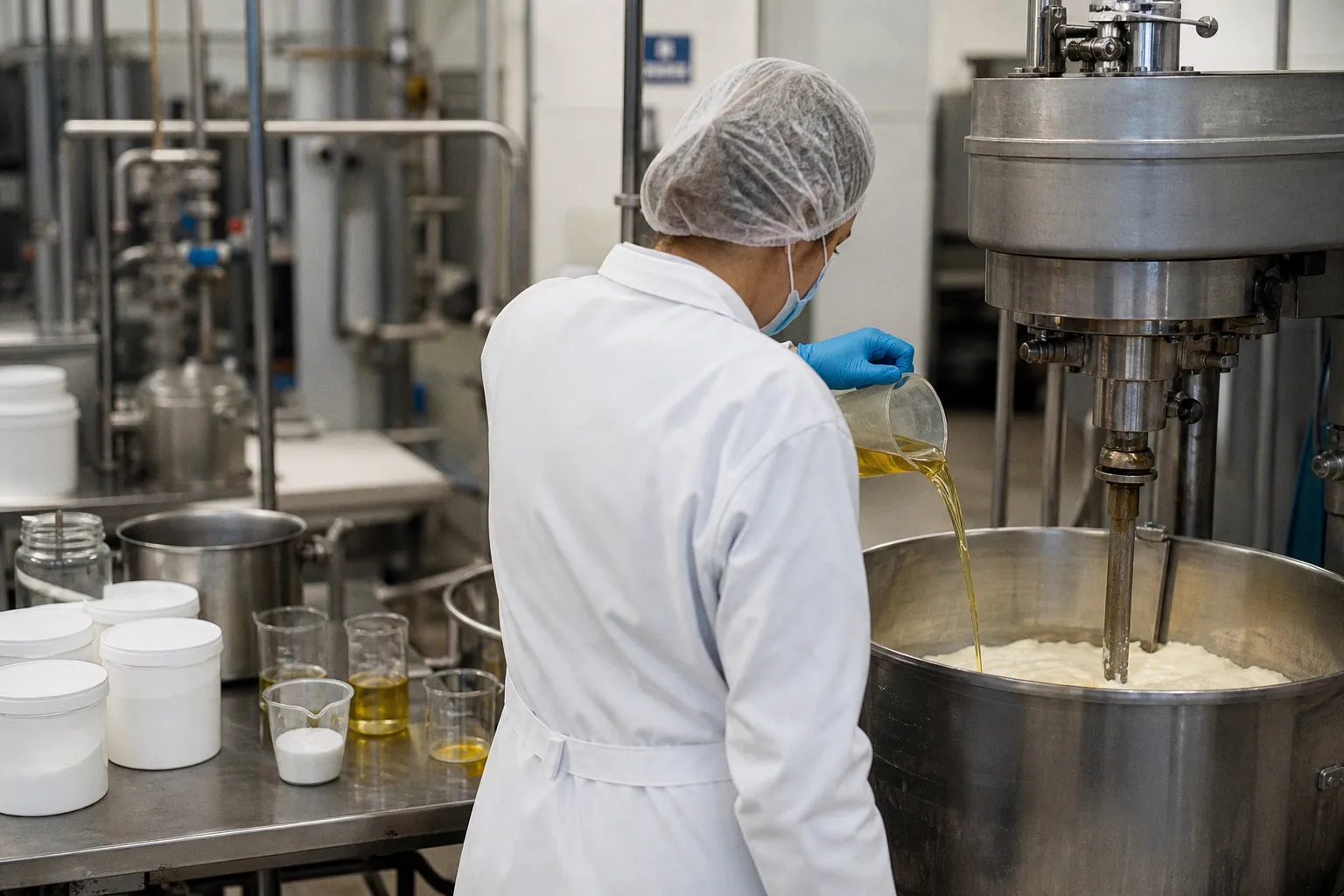
How Chemistry Governs Food Stability: A Mechanistic Breakdown
This guide examines the precise chemical mechanisms by which antioxidants, emulsifiers, humectants, pH regulators, and hydrocolloids maintain physical and microbiological stability in modern food systems. The analysis draws on regulatory thresholds (pH 4.6, water activity 0.60), standardized EU additive codes (E300–E399 for antioxidants; E400–E499 for stabilizers), and peer-reviewed trials where available.
Stability in food systems is not accidental. It is the engineered consequence of molecular interventions applied at specific thermodynamic and kinetic thresholds before degradation pathways initiate.
---
Managing Lipid Oxidation with Antioxidants and Chelating Agents
Fats and oils undergo autoxidation through a free-radical chain reaction initiated by molecular oxygen, transition metals, or photolytic cleavage. The process produces hydroperoxides and secondary aldehydes responsible for rancid off-flavors, discoloration, and nutrient loss. Preventing this cascade requires two chemically distinct intervention strategies: free-radical scavenging and pro-oxidant metal sequestration.
Primary Antioxidants: BHA and BHT
Butylated hydroxyanisole (BHA, E320) and butylated hydroxytoluene (BHT, E321) are synthetic phenolic compounds that donate a hydrogen atom to lipid free radicals, terminating the propagation phase of oxidation. Regulatory frameworks in most jurisdictions cap their inclusion at approximately 0.02% of fat content, reflecting toxicological thresholds rather than efficacy limits. Trials indicate that even at this concentration, oxidation induction time in unsaturated vegetable oils can be extended by a factor of 3 to 8, depending on baseline polyunsaturation.
It is worth noting that BHA and BHT are not interchangeable in all matrices. BHA demonstrates greater efficacy in animal fats and baked goods, while BHT performs superiorly in vegetable oils and packaging films. Many commercial formulations combine both to exploit synergistic effects across heterogeneous lipid phases.
Secondary Antioxidants and Chelating Agents
Transition metals — particularly copper and iron — catalyze Fenton-type reactions that generate hydroxyl radicals and dramatically accelerate lipid peroxidation. Chelating agents, or sequestrants, bind these metals into stable coordination complexes, removing them from the catalytic cycle. EDTA (E385) is the most widely deployed synthetic chelator in food matrices, though citric acid (E330) functions as a milder natural alternative by forming weak coordination complexes with ferric ions.
| Agent | E-Number | Mechanism | Typical Application |
|---|---|---|---|
| BHA | E320 | Free-radical scavenging | Animal fats, cereals |
| BHT | E321 | Free-radical scavenging | Vegetable oils, packaging |
| EDTA | E385 | Metal ion chelation | Dressings, canned vegetables |
| Citric acid | E330 | Weak chelation, pH buffering | Beverages, jams |
Do not assume that "natural" antioxidants — such as tocopherols (vitamin E) or rosemary extract — are categorically less effective than synthetic phenolics. Trials indicate that mixed tocopherol systems can achieve induction time extensions comparable to BHA in certain oil matrices, though they are more susceptible to degradation at frying temperatures above 180°C.
---
Stabilizing Immiscible Phases through Molecular Emulsification
Oil and water do not mix. This thermodynamic reality, governed by positive interfacial free energy, creates phase separation in any system where hydrophobic and hydrophilic components coexist without molecular mediation. Emulsifiers resolve this incompatibility by positioning amphiphilic molecules at the oil-water interface, reducing interfacial tension and generating kinetic stability against coalescence.
Lecithin and Mono-/Diglycerides
Lecithin (E322), a phospholipid mixture typically extracted from soy or sunflower, is the most prevalent natural emulsifier in food manufacturing. Its molecular structure — a glycerol backbone esterified with two fatty acids and a phosphate group — provides simultaneous hydrophobic and hydrophilic domains that orient at the interface. The hydrophilic-lipophilic balance (HLB) value for lecithin sits between 4 and 8, classifying it as a water-in-oil emulsifier suitable for margarine and chocolate viscosity control.
Mono- and diglycerides (E471), produced by controlled glycerolysis of triglycerides, offer greater HLB flexibility depending on the degree of esterification. These emulsifiers stabilize oil-in-water systems in bakery products, ice cream, and mayonnaise by preventing droplet coalescence during storage.
The Mechanistic Outcome
Emulsification does not produce thermodynamic stability — emulsions remain metastable systems with finite shelf life governed by Stokes' law and Ostwald ripening kinetics. However, the kinetic stability conferred by emulsifiers is commercially sufficient to maintain sensory uniformity across typical retail timelines of 6 to 18 months. Commercial mayonnaise, for instance, contains approximately 70% to 80% oil phase stabilized by 0.5% to 1.5% egg yolk lecithin, achieving multi-year ambient stability without separation.
---
Controlling Water Activity and Microbial Growth with Humectants
Microbial growth requires available water, quantified as water activity (aw) — the ratio of partial vapor pressure of water in a substrate to that of pure water. Most bacterial pathogens cannot proliferate below aw 0.86, and most spoilage molds are inhibited below aw 0.70. Intermediate-moisture foods (aw 0.60–0.85), such as dried fruits, soft cheeses, and confectionery, occupy a narrow stability window maintained by humectants.
Glycerol, Sorbitol, and the Binding of Free Water
Humectants function by hydrogen-bonding to free water molecules, reducing the proportion available for microbial metabolism without removing moisture from the product matrix. Glycerol (E422) and sorbitol (E420) are the dominant humectants in commercial use, with glycerol offering higher hygroscopicity and sorbitol providing reduced caloric density and lower sweetness impact.
The target threshold for microbial inhibition in shelf-stable intermediate-moisture products is aw below 0.60. Maintaining this threshold through humectant addition is more energy-efficient and texture-preserving than thermal dehydration to the equivalent water content. Data suggest that glycerol concentrations of 10% to 25% by weight are sufficient to achieve aw 0.60 in many confectionery matrices, depending on initial moisture content and sugar composition.
Texture and Sensory Trade-offs
Humectant addition is not without sensory consequence. Excessive glycerol concentrations produce a sweet, slightly viscous mouthfeel that may be undesirable in savory applications. Formulators balance humectant concentration against target aw, matrix pH, and sensory specifications — a multidimensional optimization problem rather than a single-variable adjustment.
---
Acidification and pH Regulation for Pathogen Inhibition
The threshold pH 4.6 is one of the most operationally significant numbers in industrial food chemistry. Below this value, the majority of pathogenic bacteria — including Clostridium botulinum — cannot germinate, produce toxin, or multiply at rates sufficient to cause foodborne illness. Acidification to this threshold is therefore a primary preservation strategy across sauces, dressings, beverages, and pickled products.
Organic Versus Mineral Acidulants
Citric acid (E330), acetic acid (E260), and lactic acid (E270) are the principal organic acidulants, each contributing distinct flavor profiles alongside their pH-reducing function. Phosphoric acid (E338) is the dominant mineral acidulant, particularly in cola beverages and processed cheeses, where its cleaner taste profile and higher dissociation constant allow precise pH control without introducing competing flavor notes.
Buffering capacity matters as much as absolute pH. A solution adjusted to pH 4.0 with a weak acid and its conjugate base resists pH drift through dilution or microbial metabolite production, whereas strong mineral acids lack this intrinsic buffering and require more careful formulation. Data suggest that buffered acid systems extend lag-phase duration in Listeria monocytogenes and Salmonella spp. by 200% to 400% compared with unbuffered systems at equivalent initial pH.
Regulatory Framework
The U.S. Food Safety Modernization Act (FSMA), signed in 2011, and the EU Regulation 1333/2008 on food additives establish mandatory hazard analysis and critical control point (HACCP) protocols for acidified foods. Processors must demonstrate through validated time-temperature-pH integrations that products remain below pH 4.6 throughout their commercial lifecycle, not merely at the point of manufacture.
---
Hydrocolloid Networks and the Prevention of Syneresis
Syneresis — the spontaneous expulsion of liquid from a gel network — compromises texture, visual appeal, and shelf stability in dairy desserts, plant-based milks, and restructured meats. Hydrocolloid stabilizers prevent this phenomenon through the formation of three-dimensional polymer networks that immobilize free water within the matrix.
Xanthan Gum and Carrageenan
Xanthan gum (E415) produces high-viscosity aqueous solutions at low concentrations (0.1% to 0.5%) and exhibits pseudoplastic flow behavior — viscosity decreases under shear, allowing pourability, then recovers at rest to prevent settling. This rheological profile makes xanthan ideal for salad dressings and gluten-free baked goods, where it substitutes for the structural contribution of gluten proteins.
Carrageenan (E407), extracted from red seaweed, forms thermoreversible gels in the presence of potassium or calcium ions. Its three principal fractions — kappa, iota, and lambda — offer distinct gel textures ranging from firm and brittle (kappa) to soft and elastic (iota) to non-gelling thickener (lambda). Commercial chocolate milk typically employs carrageenan at 0.02% to 0.05% to suspend cocoa particles and prevent whey separation during refrigerated storage.
Concentration Thresholds and Synergy
Hydrocolloid performance is rarely optimized in isolation. Combinations of xanthan gum with locust bean gum (E410) generate synergistic gel networks with elasticity exceeding either component alone. Similarly, carrageenan paired with guar gum (E412) provides viscosity and suspension stability in dairy alternatives without the flavor carry-through that some hydrocolloids introduce.
| Hydrocolloid | E-Number | Primary Function | Typical Inclusion |
|---|---|---|---|
| Xanthan gum | E415 | Viscosity, suspension | 0.1%–0.5% |
| Carrageenan | E407 | Gelation, stabilization | 0.02%–0.05% |
| Locust bean gum | E410 | Gel synergy | 0.1%–0.3% |
| Guar gum | E412 | Thickening | 0.1%–0.5% |
---
Final Verdict
Food stability is not a marketing claim — it is a measurable outcome governed by specific molecular interventions at defined thermodynamic and biochemical thresholds. The chemical additives discussed here — antioxidants within the E300 range, emulsifiers and stabilizers within E400, pH regulators, and humectants — represent decades of iterative formulation science validated by regulatory frameworks including the 1958 Food Additives Amendment and the 2011 FSMA. Trials consistently demonstrate their efficacy in extending shelf life, preventing pathogen proliferation, and maintaining sensory consistency across commercial timelines.
For readers interested in the broader economic and commodity-driven implications of these chemical inputs on consumer pricing and market structure, borsaclub.com offers analysis of how manufacturing decisions in regulated industries translate into observable market effects.
The evidence is unambiguous: chemical intervention in food production is not optional. It is the operational prerequisite for the modern food supply chain.