Food processing equipment market trends 2026: setup guide
Think “food processing equipment market trends 2026” just means shinier mixers, smarter ovens, and a few vendors saying “AI-enabled” until the booth carpet catches fire? Nice fantasy.
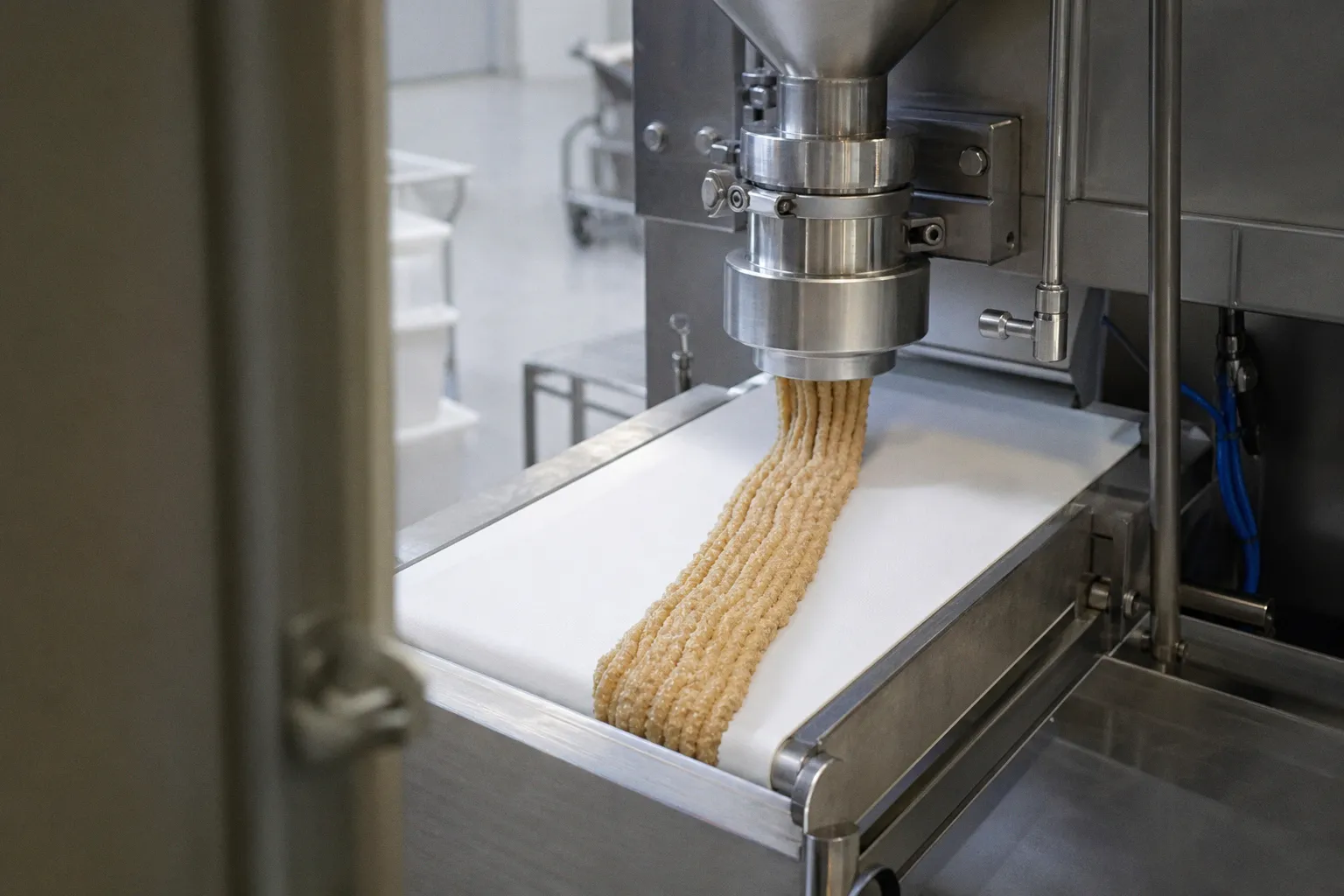
The market is big, but even the analysts can’t agree how big. One forecast puts the global food processing equipment market at about USD 62.97 billion in 2026, heading toward USD 95.18 billion by 2034 at 5.30% CAGR. Another places 2026 closer to USD 59.0 billion, growing to USD 78.7 billion by 2033 at 4.2%. A third estimate lands higher, around USD 77.24 billion. That spread tells you something useful: don’t treat market numbers like gospel. Treat them like smoke from the factory roof. Something is definitely running hot.
The 2026 market: bigger, smarter, and less forgiving
Food processors are not buying equipment in 2026 because they suddenly discovered stainless steel. They are buying because old lines are too slow, labor is too scarce, sanitation windows are too tight, and compliance people have learned how to read drawings. A dangerous development for everyone who still thinks a “washdown-rated” sticker solves microbiology.
The growth story is steady rather than explosive. Depending on whose model you trust, the market is moving in the low-to-mid single-digit CAGR range. That sounds boring until you remember the base is already around USD 60 billion-plus. In this industry, “steady growth” means a lot of conveyors, cutters, retorts, fillers, freezers, depositors, formers, dryers, ovens, pumps, sensors, valves, and control cabinets getting specified, shipped, bolted down, and argued over.
The practical drivers are clear:
- Automation in food processing 2026 is no longer a premium toy. It is how plants keep throughput stable when labor availability behaves like a badly tuned auger.
- Food safety compliance is pushing design decisions upstream. You cannot sanitize a dead leg out of existence with optimism and hot water.
- IoT and data capture are moving from brochure fluff to line management. Downtime, yield loss, temperature deviation, and cleaning verification are now numbers, not folklore.
- Protein processing keeps pulling hard. Meat, poultry, and seafood processing equipment is expected to dominate by equipment type in 2026, driven by global meat production and preference for protein-rich foods.
- Asia-Pacific is the heavy-growth region. Expanding food processing industries in India and China are a major reason the region is expected to hold the largest share.
Here is the blunt version: processors are buying equipment that can run longer, clean faster, document better, and fail less dramatically.
The cheapest machine on quote day often becomes the most expensive object in the building once sanitation, downtime, and rejected product get a vote.
What the market numbers actually tell you
The valuation spread matters because procurement teams love one clean number. Sorry. Not this time.
| Forecast lens | 2026 estimate | Later projection | What you should take from it |
|---|---|---|---|
| Fortune Business Insights | USD 62.97 billion | USD 95.18 billion by 2034 | Strong long-term growth, 5.30% CAGR |
| Grand View Research | USD 59.0 billion | USD 78.7 billion by 2033 | More conservative growth, 4.2% CAGR |
| Meticulous Research | USD 77.24 billion | Forecasts out to 2036 | Higher base estimate; useful as an upper-market signal |
Do not build a capital plan around one analyst’s decimal point. Use the range. If every forecast says the same direction — up — but argues over the starting line, the trend is real and the precision is theater.
For a facility team, the market signal is not “buy now because the graph is pretty.” It is this: suppliers will be busy, lead times can stretch, automation talent will be fought over, and hygienic design upgrades will not get cheaper when everyone else is chasing the same stainless parts.
Hygienic design in 2026: NSF/ANSI 2-2025 is not wallpaper
The updated NSF/ANSI 2-2025 standard for food handling equipment deserves more than a sleepy nod from the quality manager. Standards are where nice equipment ideas go to become non-negotiable details.
The 2025 update includes several meaningful changes: notes on food containers and utensils were converted into normative text, a new section was added on glass and glass-like coatings, and the term “butcher blocks” was removed. That last one sounds minor. It is not. Language in standards shapes what auditors, engineers, and equipment builders can argue about. Remove fuzzy terms, add enforceable text, and suddenly the spec sheet has fewer hiding places.
If you are setting up a food processing facility, hygienic design is not just about food-contact surfaces. Everyone remembers the shiny product zone. Fewer people inspect the hollow frame under it, the roller ends, the fastener penetrations, and the underside welds where biology likes to open a small, disgusting retirement account.
Hygienic design principles are brutally practical:
1. Hollow areas need to be sealed, not wished clean. Frames and rollers should be hermetically sealed with continuous welds where hollow construction is used. If liquid, soil, or condensate can enter, bacteria can settle in and send postcards.
2. Avoid fastener penetrations into hollow tube construction. A bolt through a hollow tube can become a microbial apartment block with terrible plumbing.
3. Food-contact materials must fit the product and process. 304 stainless steel works in many applications. 316 stainless steel is used where corrosion resistance demands it. Do not chant “316” like a spell. Use the right alloy for acid, salt, cleaning chemistry, temperature, and exposure time.
4. Glass and glass-like coatings need real control. If a coating can chip, crack, or shed, it belongs in the risk assessment, not in the “probably fine” drawer.
5. Cleanability beats cosmetic polish. Smooth welds, accessible surfaces, drainability, and tool-free disassembly often matter more than the machine looking expensive.
This is where sustainable food processing equipment also becomes less fluffy. A machine that cleans with less water, uses less chemical, avoids rework, reduces product loss, and survives proper sanitation is more sustainable than a brochure leaf icon slapped next to a motor.
The materials trap: 304 vs 316 stainless steel
Food equipment buyers often ask the wrong question: “Is it stainless?” That is like asking whether a vehicle has wheels. Helpful, but barely.
| Material choice | Where it often fits | Where it can bite you |
|---|---|---|
| 304 stainless steel | General food-contact surfaces, dry or mildly corrosive environments, many standard processing lines | High chloride, aggressive sanitation chemistry, salty or acidic products |
| 316 stainless steel | More corrosive environments, higher salt exposure, harsher cleaning regimes, certain acidic products | Higher cost; not automatically required everywhere |
| Non-metal food-grade materials | Belts, seals, gaskets, scrapers, bushings, some coatings | Wrong polymer choice can swell, crack, absorb, or fail under heat and chemicals |
The trick is matching material to abuse. Your product abuses the equipment. Your cleaning crew abuses it again. Your maintenance team then adds their own special seasoning. Design for all three.
Facility layout: dirty-to-clean is the law of gravity
A food plant should move from dirty to clean. Raw to processed. Unopened packaging to exposed product to sealed product. Waste away from finished goods. People, tools, drains, air, forklifts, and ingredients should not wander around like extras in a disaster movie.
The dirty-to-clean flow protocol is the backbone of facility setup. If you get it wrong, every fix becomes expensive: walls move, drains relocate, air handling changes, conveyors need bridges, and employees invent “temporary” workarounds that last until retirement.
How it actually works:
1. Start with receiving and raw material risk. Raw meat, seafood, soil-bearing produce, allergens, and high-moisture ingredients do not carry the same microbial or cross-contact profile. Group them honestly.
2. Map product movement before equipment placement. Do not drop a new filler into the only available rectangle and then discover carts cross the raw staging area.
3. Separate exposed product from dirty traffic. Forklifts, pallets, trash, outer cartons, and maintenance tools are not neutral. They carry grime, splinters, moisture, and bad decisions.
4. Control people flow. Changing rooms, handwash stations, boot controls, PPE zones, and sanitation entry points must support the hygiene zoning. If the fastest walking route violates the plan, the plan loses.
5. Give drains a vote early. Drain slope, capacity, location, and cleanout access make or break wet processing rooms. Nobody brags about drains at trade shows. Everyone curses bad ones later.
6. Leave expansion room. Designers often recommend keeping three sides of the building open when possible so future expansion does not require architectural surgery.
A good facility layout does not make employees “be careful.” It makes the wrong movement inconvenient and the right movement obvious.
There is a parallel here with how good classroom technology should support learning instead of becoming a shiny distraction; the same logic shows up in arguments for better technology rather than less of it — tools earn their place when they improve the system, not when they merely look modern.
In a processing plant, that means the best equipment is not the fanciest unit sitting alone on a skid. It is the machine that fits the flow, the sanitation regime, the utilities, the maintenance access, and the expansion plan without turning the building into a stainless maze.
Utility matching: the boring part that shuts down the line
You can buy the right machine and still botch the installation. Happens constantly. The quote gets approved, the crate arrives, everyone admires the horsepower, and then someone discovers the facility cannot feed the beast.
Utility matching is not clerical work. It is survival.
Before equipment lands on the floor, verify:
- Voltage, phase, and amp requirements. A machine specified for one electrical service does not magically cooperate with another because the production manager has a launch date.
- Panel capacity and disconnect placement. Automation-heavy lines need clean power planning, safe isolation, and room for future loads.
- Water pressure and volume. Wash systems, blanchers, boilers, steam injection, CIP skids, and cooling systems all make demands. “We have water” is not an engineering answer.
- Water filtration and treatment. Product water, boiler feedwater, cleaning water, and ingredient water may need different treatment. Pretending all water is the same is how scale, flavor problems, and equipment damage arrive.
- Gas type and pressure. Natural gas and propane are not interchangeable vibes. Burners, ovens, fryers, and boilers must be matched to fuel type and pressure.
- Compressed air quality. If air contacts food or food-contact surfaces, oil, moisture, and microbial load matter. Instrument air and product-contact air are not the same animal.
- Drainage capacity. A sanitation cycle can release a lot of water quickly. If the drain cannot take it, the floor becomes the process.
Automation adds another layer. Food manufacturing technology updates in 2026 are not just robots and dashboards. They include sensors, PLC integration, recipe control, traceability, predictive maintenance, and data historians. Lovely things. Also fragile if the plant network is an afterthought.
A useful automation plan answers five questions before installation:
1. What data must be captured? Temperature, pressure, weight, flow, belt speed, metal detection events, batch IDs, allergen changeovers, downtime codes — choose what matters.
2. Who owns the data? Production wants speed. Quality wants records. Maintenance wants fault history. Corporate wants dashboards. If nobody owns it, everyone complains.
3. What happens when the network fails? A line should fail safe, not fail mysterious.
4. Can operators actually use the interface? A touchscreen with 47 nested menus is not advanced. It is a prank.
5. Can maintenance troubleshoot it at 2 a.m.? If only one integrator three time zones away understands the code, congratulations, you bought a dependency.
Equipment selection: buy the process, not the machine
The food industry machinery trends 2026 conversation gets noisy fast: automation, IoT, energy efficiency, hygienic design, modularity, robotics, advanced sensors. Fine. But the first question is still old-fashioned: what does the product need?
A sauce line, a frozen entrée line, a poultry deboning operation, and a fermented beverage plant are not variations on the same theme. They have different rheology, heat transfer, particle integrity, microbial risk, allergen exposure, oxygen sensitivity, cleaning demands, and packaging constraints.
When you evaluate equipment, separate shiny features from process fit.
Ask process questions before vendor questions
A competent specification starts with the food, not the brochure.
- Product behavior: Is it pumpable, shear-sensitive, sticky, abrasive, foaming, chunky, fragile, viscous, or prone to separation?
- Thermal needs: Does it need rapid heating, gentle cooling, holding time, surface browning, freezing, drying, or pasteurization?
- Microbial risk: Is it ready-to-eat, raw, high-moisture, low-acid, refrigerated, shelf-stable, or fermented?
- Allergen profile: How often do you change over? Can the equipment be cleaned and verified fast enough to make the schedule real?
- Throughput target: Peak rate matters, but so does average rate after stops, cleaning, changeovers, and operator adjustments.
- Yield sensitivity: A cutter that smears, a pump that breaks particulates, or a depositor that overfills by a few grams can quietly eat margin all day.
- Sanitation window: If cleaning takes six hours and your schedule allows four, the machine is not “efficient.” It is a liar.
This is also where equipment segment dominance matters. Meat, poultry, and seafood processing equipment is expected to lead in 2026 for a reason. Protein lines are technically demanding: high microbial risk, heavy washdown, cold rooms, bone fragments, fat smearing, variable raw material, labor pressure, and aggressive sanitation. Equipment in that segment has to work hard and clean hard. No spa days.
Regional and segment trends: Asia-Pacific pulls, protein dominates
The Asia-Pacific region is expected to account for the largest share of the global food processing equipment market in 2026, with India and China driving major expansion. That does not mean every processor should copy an APAC facility model. It means equipment suppliers, component availability, manufacturing capacity, and competitive strategy will increasingly reflect demand from that region.
If you are buying in North America or Europe, this still affects you. Global demand shapes lead times. It affects motor availability, stainless fabrication slots, controls components, and OEM priorities. A supplier chasing high-growth regional projects may not treat your modest retrofit like royalty.
Segment-wise, protein processing deserves attention. Meat, poultry, and seafood equipment dominates because protein demand keeps rising and because these operations burn through equipment. Cutting, grinding, forming, coating, cooking, chilling, freezing, packaging — every stage has mechanical stress and hygiene risk.
But other categories are not standing still:
| Segment | 2026 pressure point | Equipment implication |
|---|---|---|
| Meat, poultry, seafood | Labor reduction, hygiene, throughput, cold-chain control | Automated cutting, forming, inspection, washdown-rated controls |
| Bakery and snacks | Consistency, energy use, high-volume packaging | Better ovens, depositors, conveyors, vision systems |
| Dairy and beverages | CIP validation, separation, heat treatment, filling hygiene | Advanced valves, pumps, pasteurizers, aseptic or hygienic fillers |
| Ready meals | Multi-component assembly, allergens, thermal uniformity | Modular lines, weighing systems, recipe control, fast changeover |
| Produce processing | Soil load, water management, shelf-life pressure | Washing, sorting, drying, gentle handling, sanitation zoning |
The bigger pattern is modularity. Processors want lines that can change products without rebuilding the plant. Vendors love saying “flexible.” You should ask what that means in minutes, tools, operators, validation steps, and lost product during changeover.
The setup sequence that prevents expensive stupidity
If you are planning a facility or major line in 2026, resist the urge to start with equipment quotes. That is how you end up with a beautiful machine facing the wrong drain.
Use this sequence instead.
1. Define the product family and risk class. Group products by microbial risk, allergen profile, processing method, temperature control, and packaging format.
2. Set throughput and schedule assumptions. Include changeovers, cleaning, maintenance, startup losses, and realistic labor. Perfect-world capacity is boardroom fiction.
3. Draw the dirty-to-clean flow. Raw materials, people, waste, packaging, rework, allergens, and finished goods each need a route.
4. Lock the hygiene zones. Decide where exposed ready-to-eat product lives, where raw product stops, and where traffic cannot cross.
5. Match utilities before purchase orders. Electrical service, water, gas, compressed air, steam, drainage, ventilation, refrigeration, and network infrastructure must fit the line.
6. Specify hygienic design details. Materials, welds, seals, slopes, access, fasteners, hollow sections, and cleanability need written requirements.
7. Plan automation and data capture. Decide what the system records, how operators interact with it, and how quality gets usable evidence.
8. Review maintainability. Can technicians access motors, belts, bearings, sensors, valves, and panels without dismantling half the line?
9. Leave expansion space. Three open sides of a building is ideal when possible. At minimum, avoid boxing yourself into a corner with utilities and walls.
10. Commission like you mean it. Test product performance, sanitation, utilities, safety systems, controls, and documentation before commercial pressure turns every defect into “temporary acceptance.”
That last point matters. Commissioning is where fantasy meets gravy, brine, dough, fat, steam, and cleaning foam. Run real product. Run worst-case product. Run sanitation. Then open the machine and look where nobody wants to look.
Common mistakes that still happen in expensive plants
The industry has better tools than ever and still repeats the same sins. Very human. Very costly.
Mistake one: buying for nameplate speed. A filler that runs 300 units per minute for 20 glorious minutes but takes forever to change over may lose to a slower machine with better uptime.
Mistake two: ignoring product rheology. Viscosity, particle size, shear sensitivity, and temperature behavior decide whether pumps, valves, and depositors behave. Food is not water with branding.
Mistake three: treating sanitation as a shift problem. Sanitation difficulty is designed into equipment. The night crew does not owe you miracles because engineering approved bad access.
Mistake four: underbuilding utilities. The line that “almost” has enough water pressure, drainage, air, or amperage will almost make schedule. Enjoy that word.
Mistake five: adding automation without process discipline. Automation makes stable processes better. It makes chaotic processes fail with more expensive alarms.
Mistake six: forgetting maintenance access. If a bearing requires three people, two ladders, and a prayer to replace, it will not be replaced when it should be.
Mistake seven: confusing compliance with quality. Meeting a standard is the floor. It is not a guarantee that your specific product, cleaning chemistry, and production schedule will behave.
Bottom line: how to act on 2026 trends
The food processing equipment market in 2026 is growing, but the useful story is not the headline valuation. It is the operational squeeze underneath it. More automation. More hygienic design scrutiny. More data. More demand from protein processing. More regional pull from Asia-Pacific. More pressure to build plants that can expand without becoming plumbing archaeology.
If you are setting up or upgrading a facility, keep the checklist short and sharp:
- Build the flow from dirty to clean before you place equipment.
- Treat NSF/ANSI 2-2025-style hygienic design details as design inputs, not audit decorations.
- Match voltage, phase, amps, water, gas, air, drainage, and network requirements before the machine ships.
- Specify materials by product and cleaning exposure, not by stainless-steel superstition.
- Buy automation only when you know what data, decisions, and failures it must handle.
- Judge equipment by cleanability, uptime, yield, changeover, and maintenance access — not booth lighting.
The market is moving. That part is easy. The harder part is making sure your plant moves product in one direction, risk in the other, and cash somewhere other than the drain.